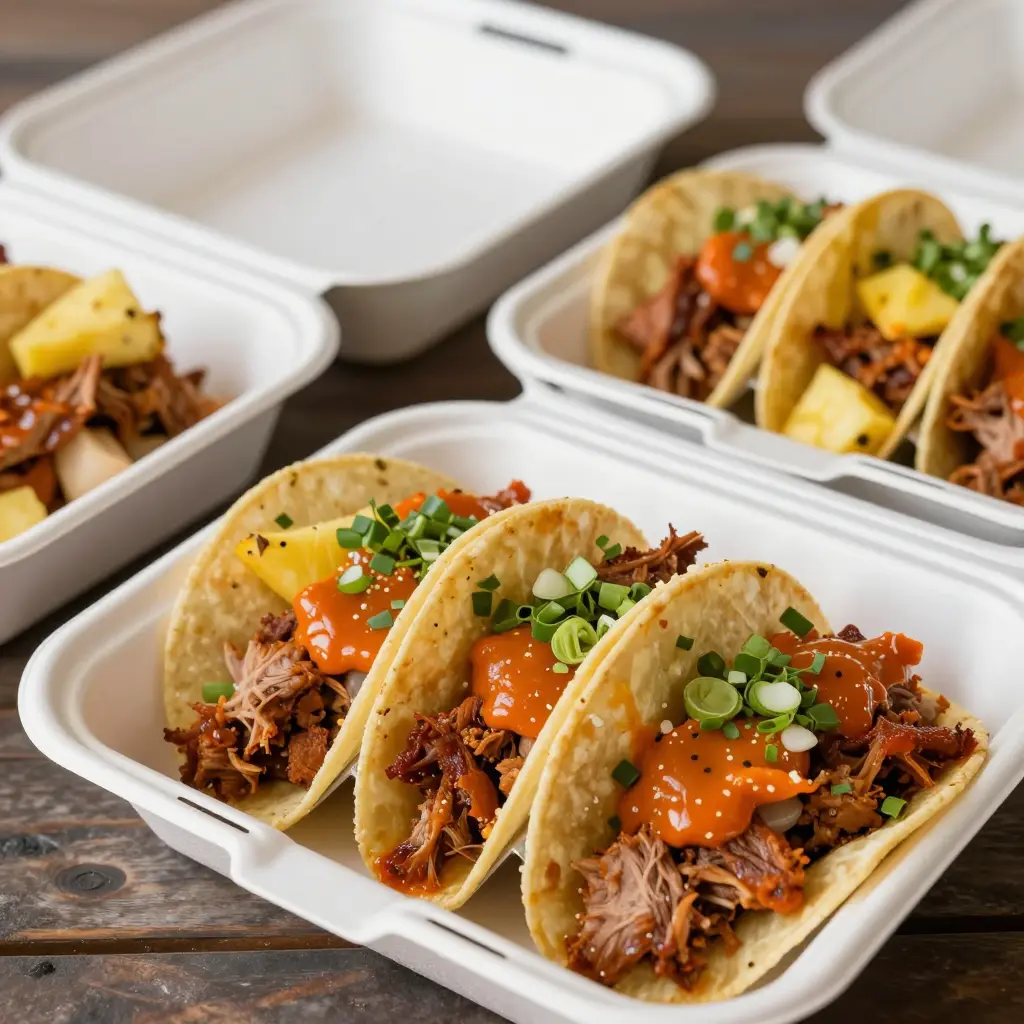
What the El Pastor del Rico Dinner Service Is
The El Pastor del Rico dinner service is the evening meal program built around al pastor trompo cooking: pork marinated in achiote and chile adobo, stacked on a vertical spit, roasted, and carved to order for tacos, tortas, and burritos. It starts in the late afternoon and runs to close, when demand shifts from quick lunch traffic to family platters, catering orders, and takeout.
Three things decide whether that service holds up night after night: the color of the adobo, when the pineapple goes on the spit, and what the takeout containers cost. Adobo color is the visual signature of the meat, the deep red-orange tone that tells a guest the pork was marinated properly and the chiles are in balance. Pineapple timing decides when the fruit joins the trompo, which changes caramelization, sweetness, and final texture. Container cost is the packaging decision that protects margin as delivery and pickup volume grows. The full El Pastor del Rico dinner offering shows how the three come together on an evening menu.
Adobo Color: What Drives the Deep Orange-Red of El Pastor del Rico
On a dinner service, adobo color is not decoration. It is a live signal. A deep, glossy orange-red tells a customer the pork was fully marinated, properly cooked, and made with real chiles and achiote rather than food dye. Pale or grayish meat reads as under-marinated or rushed, and muddy brown reads as overcooked. Operators who treat color as a quality checkpoint make faster prep decisions and send out a plate that looks worth more.
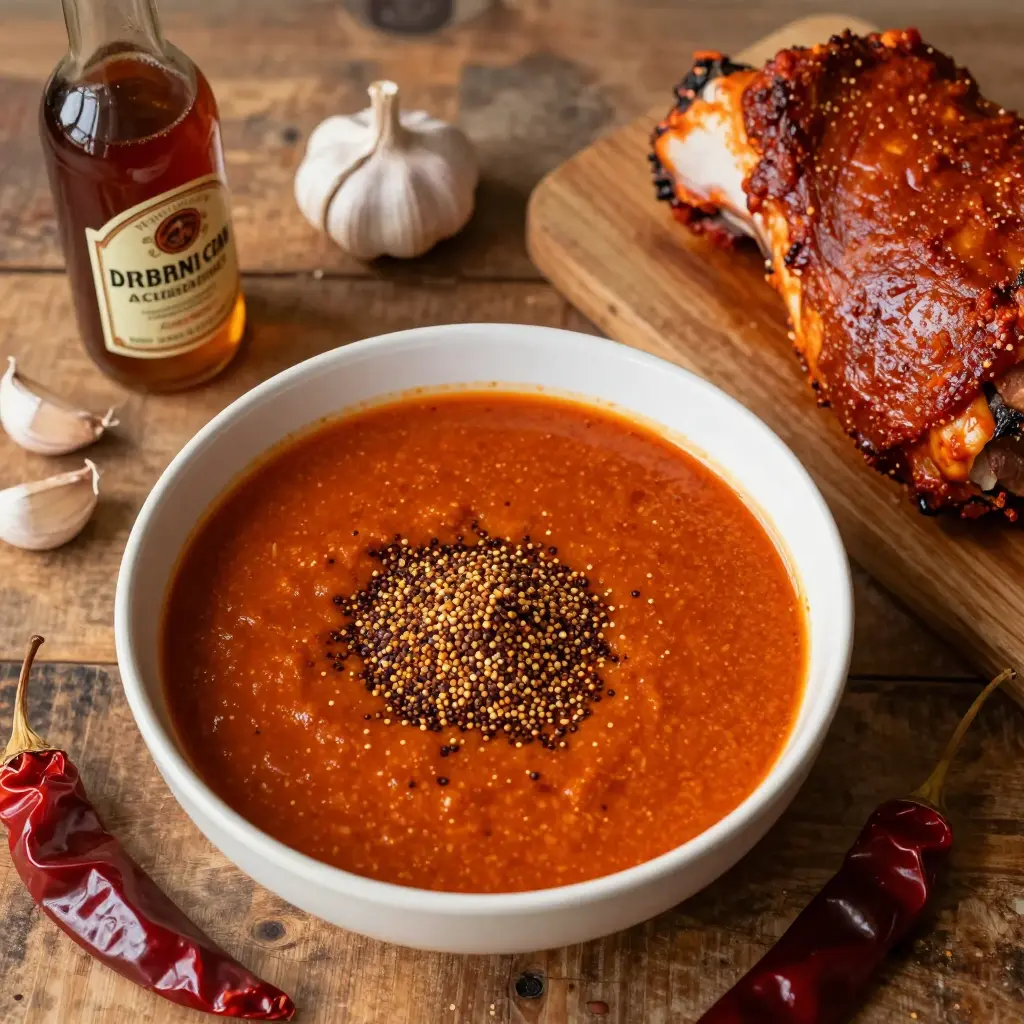
Four variables interact to produce the signature color.
- Achiote (annatto): The seed’s bixin pigment delivers the base orange. It is fat-soluble, so it binds to the fat on the pork’s surface and holds up in cooking better than a water-based colorant. Too little achiote and the result skews dull.
- Guajillo and other chiles: Guajillo supplies the deep red and mild fruitiness, ancho adds darkness, and pasilla adds depth. A guajillo-forward ratio keeps the tone warm; overloading dark chiles pushes everything toward brown.
- Vinegar and acid balance: Acid does two jobs. It denatures surface proteins slightly so pigment can penetrate, and it keeps the pH low enough that the red stays red instead of turning dull during roasting.
- Heat and browning: On the trompo or grill, Maillard browning deepens and darkens the orange-red. High heat for too long tips the color toward char rather than the target glow.
Marinating time is the clearest lever. Short soaks leave the interior pale while the surface stains quickly. Extended soaks let pigment and acid migrate deeper, producing a uniform tone that holds after slicing. The chart below shows how color intensity builds across a typical marination window.
Aim for a saturated orange-red on the exterior with a warm, slightly lighter core, roughly even from edge to center after 8 to 12 hours. Pale results usually mean too little achiote, unbalanced acid, or a soak under four hours. Muddy results come from too many dark chiles, over-browning, or a marinade that oxidized after sitting too long. Taste and check color at each stage to keep the batch consistent. A reliable adobo color standard is the foundation of a dependable pastor program, as seen in the Taquería El Pastor taco lineup.
How Adobo Color Develops
Adobo color is a progression, not a single moment. The four stages below show how raw pork goes from pale pink to the finished, deeply saturated red-orange that defines good al pastor.
Reading left to right:
- Raw pork, pale and neutral: the baseline color before any seasoning touches the meat.
- Adobo application: the marinade coats the surface and delivers the pigments, mainly from dried chiles like guajillo and ancho, that will drive the final hue.
- Absorption over time: as the pork rests, moisture migrates and the chile pigments penetrate deeper into the fibers, saturating the color from the outside in.
- Finished cooked color: heat caramelizes and deepens the surface and locks in the reddish-orange tone.
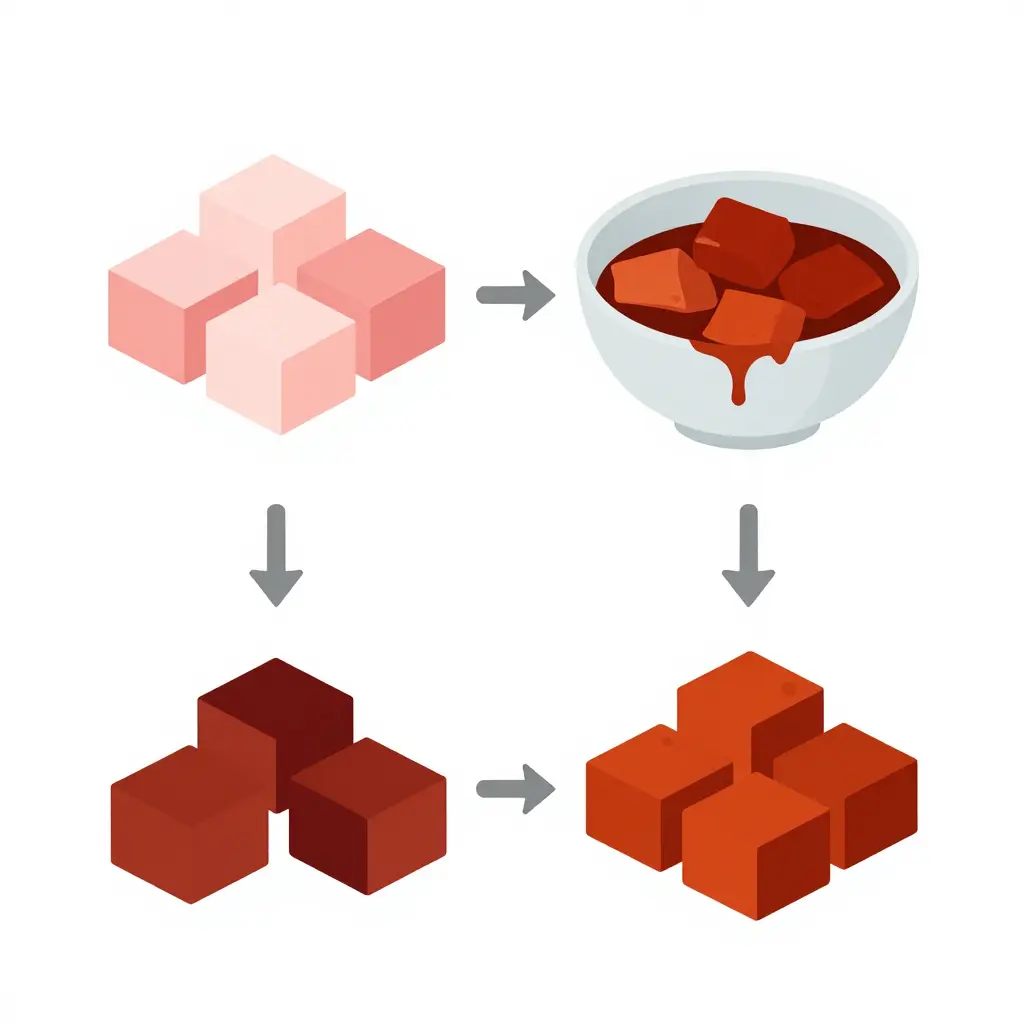
For operators, the practical point is that longer, controlled marination, not more pigment, is usually what produces the deep, even color guests associate with quality. Track your rest times the way you track El Pastor del Rico dinner service prep, and the color becomes predictable rather than accidental.
Pineapple Timing: Adding Fruit at the Right Moment in the Cook
Pineapple timing controls sweetness, texture, and caramelization at once. On the trompo and on the griddle, when the fruit goes on determines whether the final bite tastes bright and balanced or soft, watery, and flat. For anyone running a busy El Pastor del Rico dinner service, that timing is a production variable, not a garnish afterthought.
The reason is enzymatic and thermal. Pineapple contains bromelain, a protease that breaks down protein. Added early to a raw marinade, it tenderizes the pork over hours but can also turn the surface mushy and stringy. Bromelain is also heat-sensitive: once the surface of the meat is hot, the enzyme stops working, so most of its effect happens in the marinade rather than on the spit. Sugar behaves differently under heat. It caramelizes and adds color and gloss, but only when it meets a hot surface for a controlled window. Pineapple that sits on the raw stack too long releases water, dilutes the adobo, and stalls the crust. On a vertical trompo, juices drip and glaze the lower layers; on a flat griddle, the same juices pool and steam instead of sear. Early fruit pastes; late fruit sweetens without browning much.
The recommended sequence handles both problems:
- Marinate the pork with adobo and a small amount of pineapple for the short curing window, then drain.
- Skewer the meat and start the vertical cook until a firm crust forms (roughly 20-30 minutes of rotation).
- Add fresh pineapple slices near the top of the trompo during the last third of the cook, so the caramelization finishes as service begins.
- For griddle batches, put the fruit on the hot surface for the final 60-90 seconds, just before the meat is carved and plated.
Adjust by heat and volume: use less pineapple when holding times run long, and add it later as the dinner rush peaks. Handled this way, pineapple timing protects texture, locks in color, and keeps orders consistent. For more on the vertical method, see our guide to how the al pastor trompo works.
Reading Adobo Color Before the Trompo Spins
In a high-volume pastor kitchen, the color of the raw stack is the first quality signal a guest reads from across the counter, and it comes from a small set of controllable variables: how long the pork marinates, how much achiote goes in, how acidic the blend runs, the temperature at the cooking surface, and when the pineapple enters. The trick is that each one pulls color, flavor, and texture in a different direction. Push achiote for saturation and the finish can turn muddy and faintly bitter. Lean on acid for brightness and an over-marinated surface can go mushy on the griddle. The goal is a repeatable middle ground, not a maximum on any single input.
The table below condenses those trade-offs into a quick reference. Use it during prep meetings and line checks, not as a fixed recipe.
Quick-Reference Decision Grid
| Variable / Factor | Effect on Adobo Color | Effect on Flavor / Texture | Recommended Setting or Timing |
|---|---|---|---|
| Marinade duration | Longer soak deepens orange-red saturation; short soaks leave pale, patchy edges | Extended soak tenderizes and rounds the acid; too long softens the pork core | 4-12 hours refrigerated; up to 24 hours for thick shoulder cuts if the texture holds |
| Achiote ratio | Primary color driver – vivid brick-red at the sweet spot; muddy brown when overdosed | Adds earthy, peppery depth; excess turns slightly bitter, no texture change | 2-3% of meat weight (~1 tbsp paste per 2 lb) |
| Acid level (vinegar / citrus) | Mild acid brightens and locks the orange hue; heavy acid dulls toward brown | Balances richness and aids penetration; excess denatures surface proteins into mush | 1-2 tbsp per cup of marinade, pH held near 3.5-4.0 |
| Cook temperature | High heat caramelizes the marinade into a char-glow; low heat steams color flat | Searing builds crisp Maillard edges; gentle heat keeps slices juicy but pale | Sear at 400-450F surface temp; pull slices near 145F internal |
| Pineapple – early addition | Sugars burn fast, darkening adobo to near-brown and mottling the crust | Sweet notes dominate; enzymes over-tenderize the pork into paste | Avoid before first sear; reserve for slow-braise only |
| Pineapple – mid-cook | Even browning with a glossy amber edge; color holds orange-to-red | Balanced sweetness and moisture; the heat has largely deactivated the enzymes by this point | Add during the final third of cooking, once the surface has set |
| Pineapple – finishing | Minimal color shift; fruit stays bright and visually fresh | Clean tropical accent, no tenderizing effect, texture stays firm | Toss in 30-60 seconds before plating or use as a garnish |
Translating the Grid Into Service Decisions
The most common mistake is treating pineapple as one ingredient with one fixed moment. It behaves like three different tools: early pineapple is a slow-cook sweetener, mid-cook pineapple glazes and sweetens, and finishing pineapple is a garnish and flavor lift. For a dinner service where tickets fire fast, the finishing window wins. It gives you the bright, photogenic accent guests associate with signature pastor tacos while protecting the adobo color you spent the afternoon building.
On the color side, hold achiote and acid steady as your baseline, then use marinade duration and cook temperature to fine-tune. Shorten the marinade when the pork arrives already moist; drop the surface temperature slightly when you need to batch-cook ahead of a rush without scorching the crust. Write your chosen window on the prep sheet so every cook reproduces the same red instead of a lucky one-off.
Adobo color is also a cost lever. A marinade that over-darkens pushes you to use more meat to make up for visual loss, and inconsistent pineapple timing drives re-fires. Tighten these five variables and color, texture, and takeout margins move in the same direction.
Takeout Container Cost: Protecting Margin in El Pastor del Rico Dinner Service
Takeout container cost is one of the most under-managed line items in a modern restaurant, and it quietly erodes margin on every dinner order. Food cost gets weighed, portioned, and audited weekly; packaging usually disappears into a generic “supplies” category and gets paid without scrutiny. That gap is expensive. At high order volumes, a swing of even twenty cents per ticket can move monthly contribution margin by several thousand dollars.
What drives per-order packaging cost
Five variables determine what you actually pay for each outgoing order:
- Container type – a foam clamshell, a plastic hinged box, an aluminum foil pan, and a kraft bowl each carry a different price before lids, sleeves, or seals are added.
- Size – plate-size and family-size formats consume more material per unit, so matching portion to container prevents paying for empty volume.
- Material – compostable bagasse and molded fiber cost more than traditional foam or plastic, a premium that has to be priced into the menu, not absorbed silently.
- Lid design – vented, leak-resistant, and tamper-evident lids add cost up front but reduce refunds, remakes, and bad reviews downstream.
- Order volume – bulk purchasing and a consistent SKU list can cut unit cost substantially versus small, ad-hoc buys.
The table below shows how container tier and buying volume interact on a per-order basis.
| Container configuration | Retail unit cost | Bulk unit cost |
|---|---|---|
| Foam clamshell + lid | $0.16 | $0.10 |
| Plastic hinged + lid | $0.19 | $0.13 |
| Aluminum foil + lid | $0.22 | $0.15 |
| Kraft bowl + lid | $0.24 | $0.16 |
| Bagasse compostable + lid | $0.31 | $0.24 |
Container materials shape quality, not just cost
Material also affects heat retention and product quality. Foil and double-walled formats hold temperature longer, keeping al pastor, rice, and tortillas at serving heat in transit. Thin single-wall foam sheds heat quickly, so the cheapest unit can cost you in complaints and lost repeat orders. In daily takeout operations, packaging decisions are guest-experience decisions as much as pricing ones. You can see how they play out across our takeout dinner service at our al pastor restaurant near you.
Sourcing and sizing strategies that keep costs predictable
- Standardize on two or three container SKUs to unlock volume pricing and simplify inventory.
- Negotiate annual contracts with a fixed per-unit rate to shield margin from spot-price spikes.
- Forecast demand weekly and buy at tiered quantity breaks rather than in reactive small batches.
- Right-size containers to menu items, and treat packaging as a tracked cost with its own line item.
Managed deliberately, takeout container cost becomes predictable, defensible, and aligned with the quality your dinner service is known for.
Where Your Takeout Money Actually Goes
Every dinner order that leaves the kitchen carries a cost layer most operators never itemize: the packaging. The doughnut chart below breaks down the total packaging cost for a typical El Pastor del Rico dinner order into its parts, so you can see which items drive the spend.
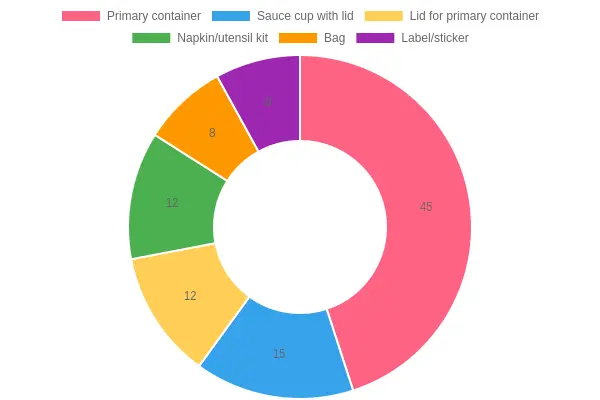
| Component | Share of Packaging Cost |
|---|---|
| Primary container | 45% |
| Sauce cup with lid | 15% |
| Lid for primary container | 12% |
| Napkin/utensil kit | 12% |
| Bag | 8% |
| Label/sticker | 8% |
The primary container and its matching lid alone account for roughly 57% of total packaging cost, so any effort to control takeout margin should start with container sourcing, not the small accessories. For a closer look at how the order is assembled and priced, see the El Pastor del Rico dinner service details.
Operational Best Practices for Running the Dinner Service
A profitable evening comes down to four things: marinade consistency, fruit timing, packaging economics, and speed. These practices support the El Pastor del Rico dinner service without adding unnecessary labor.
-
Fix the adobo recipe to a written batch card. Standardize every batch by weight rather than by eye, and post the card at the prep station so adobo color stays identical from the 4 p.m. opening to the last ticket. Consistency here protects repeat business more reliably than any single seasoning tweak.
-
Validate adobo color under real service lighting. Check the finished hue under dining-room and takeout-window lights, since kitchen fluorescents skew the reds. Catching a color problem before the rush prevents plates that look different from the photos customers order from.
-
Sync pineapple timing with the trompo rotation. Add and slice the fruit only after the outer layer of meat has rendered, tying pineapple timing to the spit’s rotation instead of the clock alone. Late pineapple stays crunchy; early pineapple steams the surface.
-
Log pineapple timing and texture per batch. A short texture note each rotation tells cooks whether to adjust pineapple timing for the next trompo. That record turns a subtle variable into a repeatable number.
-
Audit takeout container cost per order. Weigh packaging against the average ticket so takeout container cost stays under your target percentage of food revenue. Most operators find margin hiding in oversized lids and unused sauce cups.
-
Rationalize container SKUs to cut takeout container cost. Consolidate to two or three sizes and buy in higher volume to improve pricing. Fewer SKUs also speed up assembly and reduce mis-packs.
-
Build a one-way takeout assembly line. Arrange tortillas, protein, salsa, and lids in sequence so staff never double back during the dinner rush. A straight-line workflow shaves seconds off every order and keeps hot food hot.
-
Close with a documented prep-and-handoff checklist. Assign each reheated component and label station a dedicated owner, then hand off takeout orders against a printed sequence. This keeps quality steady when dinner service volume peaks.
El Pastor del Rico Dinner Service Assembly Line
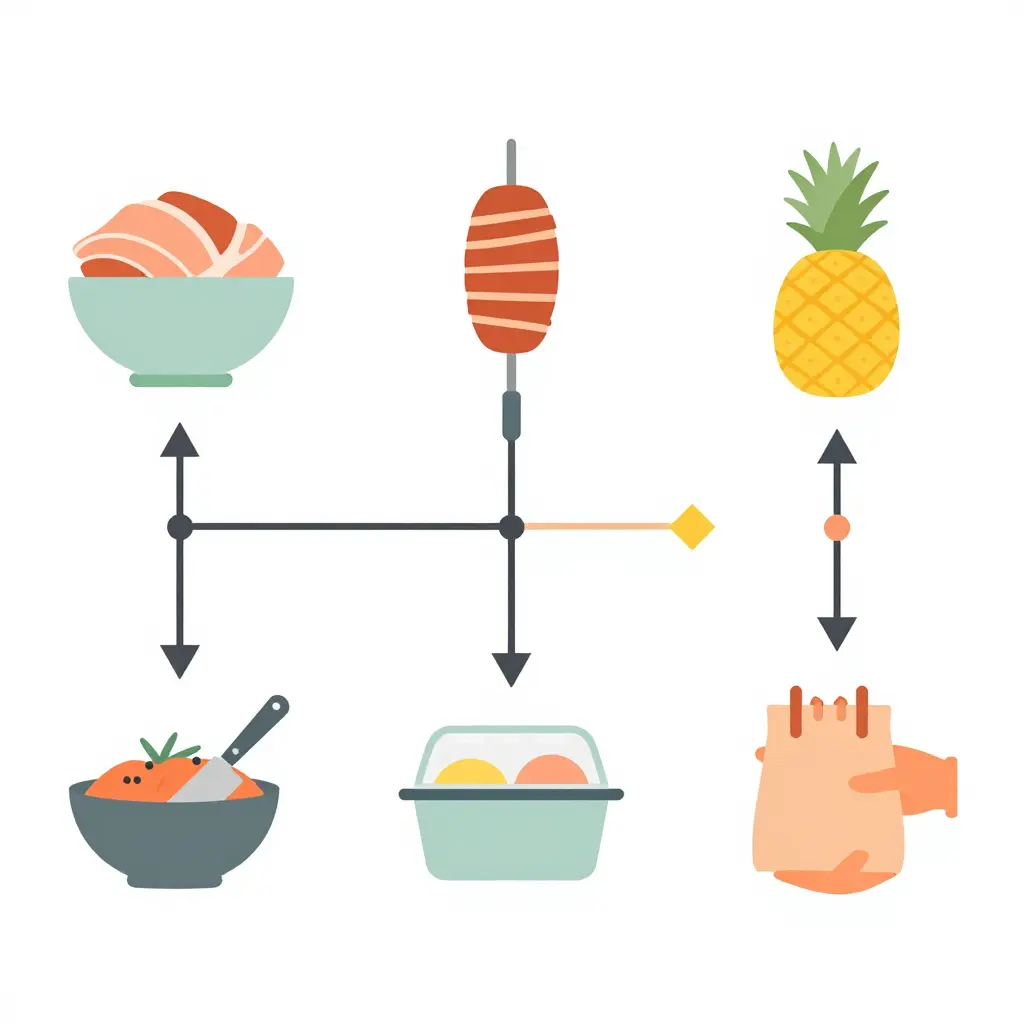
The diagram below shows the dinner service assembly line used at El Pastor del Rico: six steps, left to right, with two decision markers that flag the calls that matter most, choosing adobo color during marinating and setting pineapple timing before cooking and portioning. No text is embedded in the graphic, so it works as a staff-training handout, an SOP reference, or a quick check at the pass.
How to read the flow
- Marinating – the starting point, where the adobo color decision marker branches the process.
- Cooking – the vertical trompo cook stage that locks in flavor and crust.
- Pineapple addition – a distinct decision marker flags the timing call here.
- Portioning – controlled serving into consistent amounts.
- Container packing – sealing portions into takeout containers.
- Takeout handoff – the final step where the packed order reaches the customer.
Team members who want the operational detail behind each stage can find it in our El Pastor del Rico dinner service overview.
Bringing It Together: Color, Timing, and Cost
A dinner service rarely succeeds or fails on one decision. It usually comes down to a few controllable variables working together, and for El Pastor del Rico three of them stand out: adobo color, pineapple timing, and takeout container cost.
Adobo color sets expectations before the first bite. A deep, consistent red signals authenticity and freshness, so standardize the achiote-to-chile ratio, batch sizes, and marination windows rather than eyeballing them shift by shift.
Pineapple timing protects texture and flavor. Slice and add the fruit too early and it dulls; add it too late and the trompo comes off unbalanced. A disciplined prep schedule keeps each order crisp and bright.
Container cost erodes margin quietly. Throughput is high, so a few cents per unit compounds fast. Right-sized, heat-tolerant packaging preserves presentation and profit at the same time.
The three levers interlock. Strong color drives perceived quality and repeat orders; consistent pineapple timing holds that quality up across peak volume; disciplined container spending makes each sale earn money. Neglect one and the others weaken. An operator who treats this operational playbook for pastor taquerias as a connected system, rather than three separate chores, gets more out of all of them.
That is the practical lesson for the El Pastor del Rico dinner service: menu quality and profitability are not competing goals. They are the same goal, reached through the same habits.
Frequently Asked Questions About Adobo Color, Pineapple Timing and Takeout Container Cost
1. How long should I marinate the pork to develop the ideal adobo color?
For most kitchens, four to six hours is the minimum for a vibrant adobo color, and eight to twelve hours produces a deeper, more even tone. The achiote, guajillo, and vinegar base needs time to penetrate the meat, so very short marinades leave pale, uneven surfaces that look under-seasoned. An overnight soak of up to twenty-four hours deepens the color further, but past that point the acid starts breaking down texture without adding much color, so the returns diminish. For a reference point on how a finished plate should look, this El Pastor del Rico dinner service works as a benchmark.
2. When exactly should pineapple be added during cooking?
Pineapple’s enzymes and sugars behave differently at each stage of cooking. On a trompo, add the fruit in the last third of the rotation so it caramelizes slightly and holds its shape instead of dissolving into the marinade; on a griddle, give it the final 60-90 seconds before the meat is carved and plated. Adding it too early releases water, dilutes the adobo, and mutes the color. Bromelain does most of its work in the marinade, since heat deactivates the enzyme once the surface is hot, so a long raw soak is what makes the fruit a tenderizer rather than a garnish.
3. How can I reduce takeout container cost without hurting quality?
The most reliable method is to standardize portion sizes and match each container to its dish rather than defaulting to oversized packaging. Purchasing in higher volumes from a single supplier typically lowers takeout container cost by fifteen to thirty percent, and using a lighter gauge only for cold sides trims expenses without affecting the hot entrées. The essential step is testing a sample run across real delivery conditions, since a cheaper box that leaks or crushes will cost far more in refunds and lost repeat business.
4. Does container material affect heat retention?
Yes, and the difference is measurable over a typical delivery window of fifteen to thirty minutes. Foil-lined, double-wall or polypropylene containers retain heat noticeably longer than thin single-wall clamshells, which matters for a dish like al pastor that is best served hot. If your margins are tight, use premium insulated containers for the protein and standard packaging for sides, balancing takeout container cost against the perceived quality of the meal.
5. How do I keep adobo color consistent across batches?
Consistency comes from measuring rather than improvising, so weigh spices and achiote paste by gram and record every variable in a batch log. Using the same chile variety, toasting time, and vinegar ratio each day removes most of the color drift operators notice between shifts. Small calibrations, such as adjusting for seasonal pepper intensity, keep the adobo color stable even when suppliers change. That discipline turns an unpredictable house recipe into a reliable, repeatable menu standard.