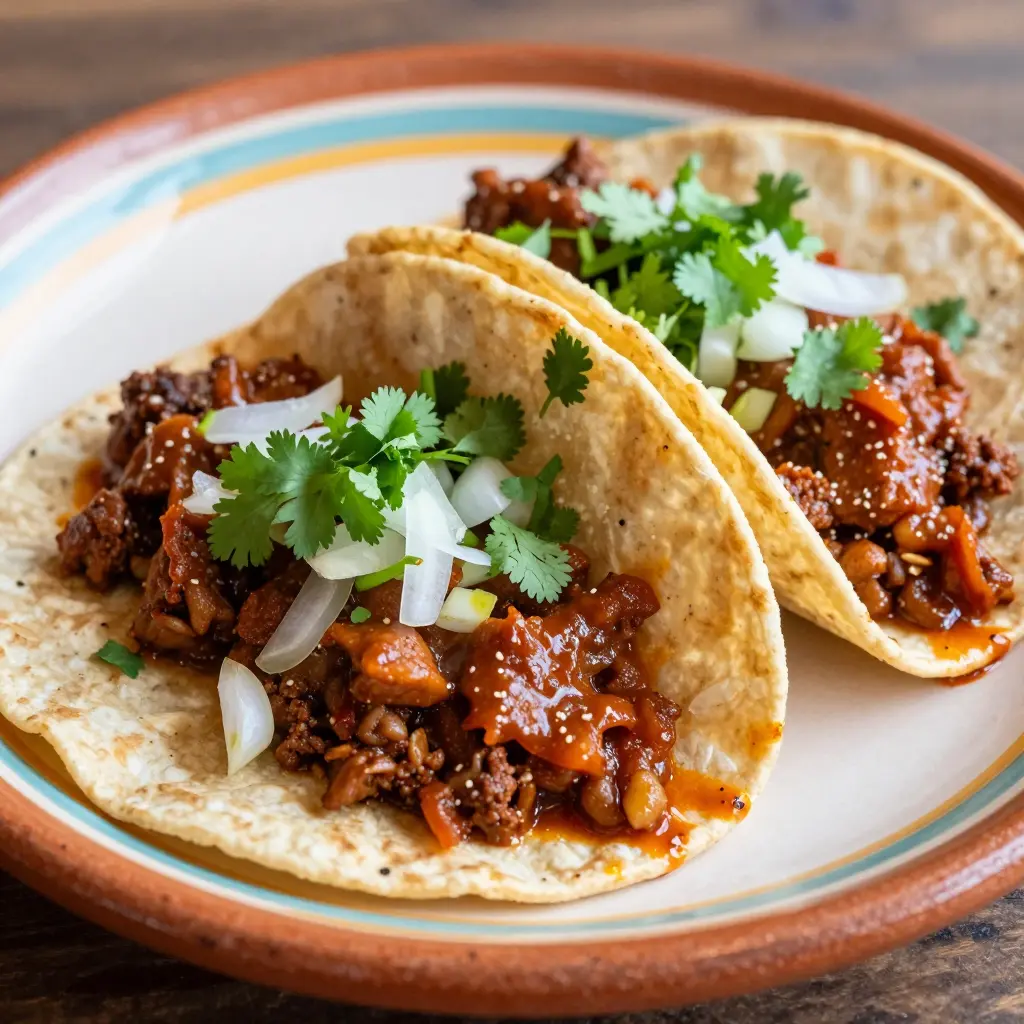
Why a Longer Marinade Isn’t Automatically a Better Marinade
In al pastor, guajillo marinade acidity and overnight pork texture loss are the same problem seen from two directions. The acid that colors and flavors the pork is also the acid that breaks it down, and the timing is what separates tender tacos from a disappointing batch.
Guajillo chiles do more than turn pork a deep, brick red. They bring a mild, fruity heat and an acidity of their own, and once you blend them with vinegar and citrus, that acid starts working on the surface of the meat.
That reaction is not always in your favor. Left too long, an acidic marinade denatures surface proteins and pulls moisture out of the meat, which is how overnight pork texture loss actually happens. You end up with edges that feel soft and waterlogged while the center stays oddly tough.
What follows is how guajillo acidity behaves on pork, why an overnight soak can wreck the texture instead of improving it, a time-and-texture comparison, and the habits that keep a batch from going mushy. If you would rather just eat the good stuff, here is where to find Al Pastor in West Allis.
Home cook or taquero, the rule is the same: marinate on a schedule, not on hope.
How Guajillo Marinade Acidity Works on Pork
The marinade starts changing the pork’s texture long before the grill is lit. The reason is guajillo marinade acidity – a measurable drop in pH that reshapes the proteins closest to the surface.
An intact pork shoulder sits near neutral, with a surface pH of about 5.6 to 6.2. A traditional al pastor marinade is far more acidic, usually landing between pH 2.5 and 3.5 once everything is blended. Muscle proteins are sensitive to a gap that wide.
The main acid sources
A classic al pastor marinade leans on several acids at once:
- Guajillo chilies – reconstituted pods add mild acidity (roughly pH 4.8-5.2) plus raisin-and-tea aromatics.
- Vinegar – usually apple cider or white, at pH 2.5-3.0.
- Citrus – orange, lime, or sour orange juice, ranging from pH 2.0 to 3.5.
- Achiote paste – earthy and gently acidic (pH 4-5), and the source of the burnt-orange color.
Blended together, the marinade pH drops, and the pork’s outer layer drops with it.
What the acid does to the surface
Acid starts denaturing surface proteins on contact. Myosin and actin, the proteins responsible for contraction, normally fold into tight, water-loving shapes. Acid disrupts those folds and makes the proteins unwind and clump, much like heat does but more slowly and only at the exterior. You can see and feel it happen: the glossy pink surface turns a duller, opaque brick red, then develops a matte, faintly rubbery film. The smell changes too, from clean raw pork to something bright and tangy with cumin, garlic, and annatto. After a few hours the surface feels tacky, then springy underneath – the first sign the proteins have unraveled.
Water-holding capacity takes a hit
Unfolded proteins lose their grip on water. As the surface pH slides toward the isoelectric point of myofibrillar proteins – around 5.0 – the net electrical charge on those proteins shrinks and they let go of moisture they once held comfortably. That is why a heavily marinated pork shoulder weeps into the bowl overnight: the meat is squeezing out water as its proteins rearrange.
When acidity turns from tenderizing to toughening
Mild acidity tenderizes. A gentle pH drop softens the surface and swells the connective tissue without wrecking it. But there is a threshold. Past roughly pH 4, or after many hours of soaking, denaturation goes too far: fibers contract hard, water floods out, and the meat turns mealy, chalky, and finally tough – the same way acid “cooks” fish in ceviche. Most al pastor recipes do well with a four-to-eight-hour soak. Push past twenty-four hours and no amount of charring will rescue the rubbery, over-acidified texture.
The cooks behind the tender, deep-red pork at Al Pastor West Allis are balancing exactly that: acid strong enough to penetrate, restrained enough to leave the fibers intact.
| Marination Time | Approximate Surface pH Shift | Texture Result | Flavor Absorption | Recommended For |
|---|---|---|---|---|
| 30 minutes | ~0.1-0.3 pH drop | Firm, springy bite | Surface-level only | Quick weeknight tacos |
| 2 hours | ~0.3-0.5 pH drop | Firm with tender edges | Mild, shallow penetration | Fast marinades, thin slices |
| 4-6 hours | ~0.5-0.8 pH drop | Tender, juicy, sliceable | Deep, balanced notes | Ideal trompo slicing |
| 8-12 hours (overnight) | ~0.8-1.2 pH drop | Very tender, softening edges | Intense, fully seasoned | Maximum flavor, thinner cuts |
| 18-24 hours-plus | ~1.2+ pH drop | Mushy, water-logged, mealy fibers | Over-saturated, harshly acidic | Not recommended – texture loss |
For cooks chasing Al Pastor West Allis, the number to remember is the 4-12 hour window. Past overnight, lingering surface acidity starts breaking muscle fibers into mush.
Why Overnight Marinating Causes Pork Texture Loss
When a pork shoulder sits in a guajillo marinade for eight hours or more, the chemistry keeps going long after the flavor has soaked in. The vinegar, the citrus, and the natural tartness behind guajillo marinade acidity never stop at the surface. They keep denaturing muscle proteins, slowly uncoiling the tight strands that give pork its structure.
As those strands unwind, they lose the ability to hold water. Moisture migrates out of the meat and collects in the bowl. The warning signs are easy to spot: a slick surface, a pale, faded color where the deep red has washed out, and liquid pooling at the bottom of the container.
What That Means Once the Slices Hit Heat
Thin al pastor slices are delicate to begin with. When already-weakened proteins meet the intense heat of the trompo and then the grill, there is little structure left to firm up. Instead of a crisp edge around a tender center, you get a fibrous, waterlogged bite – sometimes outright mushy – that shreds and steams instead of searing.
That is overnight pork texture loss in plain terms: too much time, too much acid, and a protein network that gave out before it ever touched the fire.
The Texture You Actually Want
The goal is not maximum tenderness; it is balance. A good slice of al pastor should be juicy but still have some chew – enough to remind you that you are eating pork, not paste. That structure comes from a controlled marinade window, not an all-night soak.
Around West Allis, cooks chasing authentic flavor sometimes assume longer means better. It is the opposite: timing is the technique. To see how skilled taquerias handle it, this guide to finding a proper trompo setup shows how trained cooks pair marinade time with steady fire.
Timing Principles to Follow
- Keep the soak short – two to six hours for thin-sliced pork, enough for flavor to penetrate without dissolving the structure.
- Chill the whole time – cold slows both enzyme and acid activity and protects the protein fibers.
- Taste as you go – check at the two-hour mark; if the meat feels slick and soft, stop and start cooking.
- Don’t rely on a long soak – a quick marinade plus a glaze brushed on at the grill gives you acidity and color without the breakdown.
A marinade is a seasoning, not a bath. Watch the clock, and your Al Pastor West Allis slices will stay juicy with a real chew.
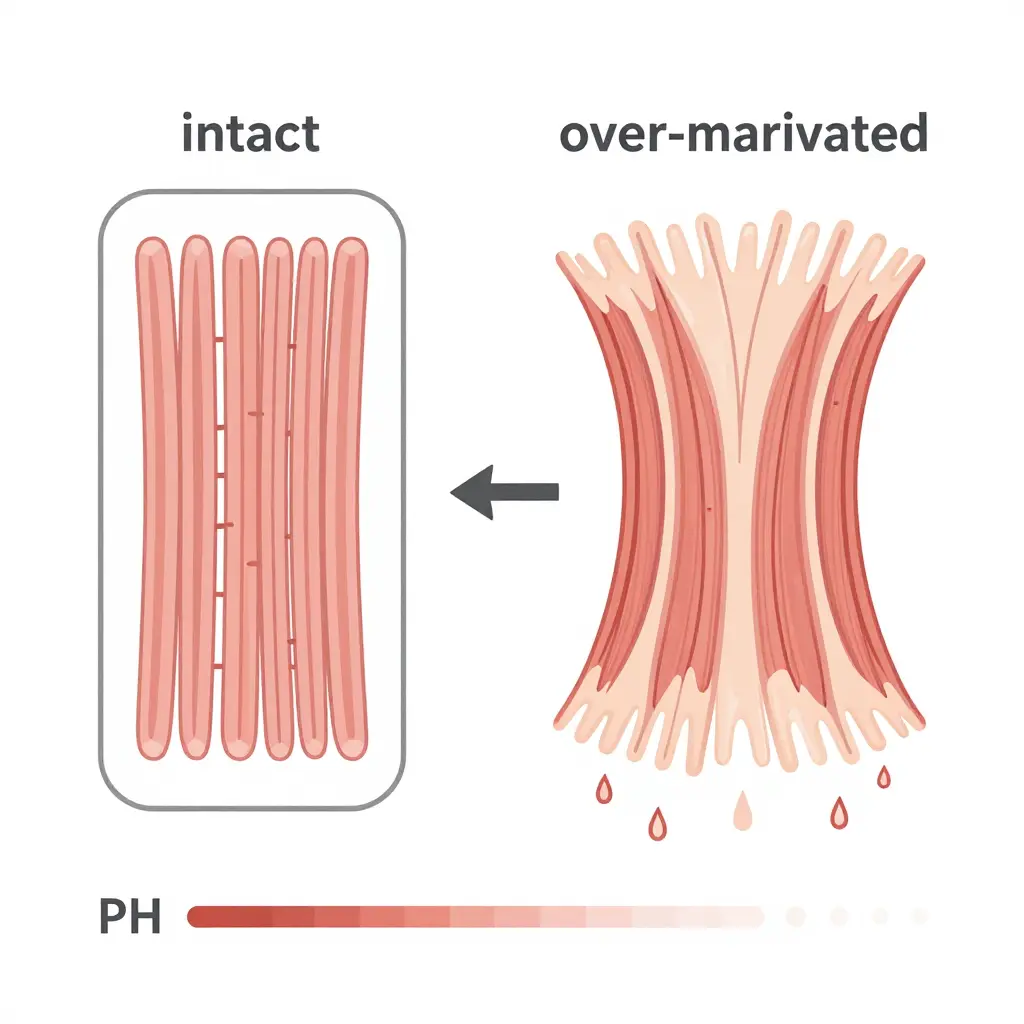
Image brief: A minimal flat 2D schematic diagram set side by side on a clean white background. The left state shows a neat, tightly packed bundle of parallel muscle fiber strands inside a crisp rounded rectangle, with short straight connector lines signaling a firm protein structure. The right state shows the same fibers splayed apart with softened, dissolving edges and small droplet symbols falling away to represent expelled moisture. A single arrow points left to right, and a thin pH gradient bar beneath shifts from tightly packed dots (low acidity) to sparse faded dots (high acidity). Simple geometric shapes, clean line-art, muted pale pink, soft beige, and warm guajillo-red accents in a flat vector editorial style. No realistic food, no textures, and no embedded text, letters, or numbers.
How to Marinate Al Pastor Without Ruining Pork Texture
Taquerias keep pork silky through long soaks by managing time, acid, and temperature, not by chasing a special ingredient. You can taste the difference in the best Al Pastor tacos near me, where the meat stays juicy and sliceable instead of collapsing into mush. These are the steps that matter.
- Shorten the marination window. Guajillo marinade acidity works fast, so aim for 4 to 8 hours rather than a full overnight soak. Longer exposure denatures surface proteins and leaves slices mealy.
- Rebalance the guajillo marinade acidity. If the blend tastes sharply tart, soften it with a milder acid such as orange juice, or stir in a pinch of baking soda, which neutralizes some of the H+ ions and slows protein breakdown.
- Keep the pork thick-sliced. Cut shoulder into 1/4- to 1/2-inch planks so the interior holds its moisture and structure while only the outermost layer absorbs the marinade.
- Salt at the right stage. Add salt a few hours in rather than overnight; a long salt soak firms the surface and can leave the meat rubbery and dry.
- Chill instead of marinating at room temperature. Refrigerate at or below 40°F. Warm marinades speed up the tenderizing enzymes that over-soften pork.
- Add pineapple late and sparingly. Fresh pineapple carries bromelain, a protease that digests muscle fibers quickly, so blend it in only for the final hour or use canned for a gentler result.
- Drain before skewering. Let the slices drip and pat them dry so the trompo builds crisp caramelized edges instead of steaming in pooled liquid – the same care you find in great Al Pastor West Allis kitchens, where a dry surface means a proper sear.
Follow these habits and the pork stays tender, sliceable, and full of that deep guajillo color from the first cut to the last taco.
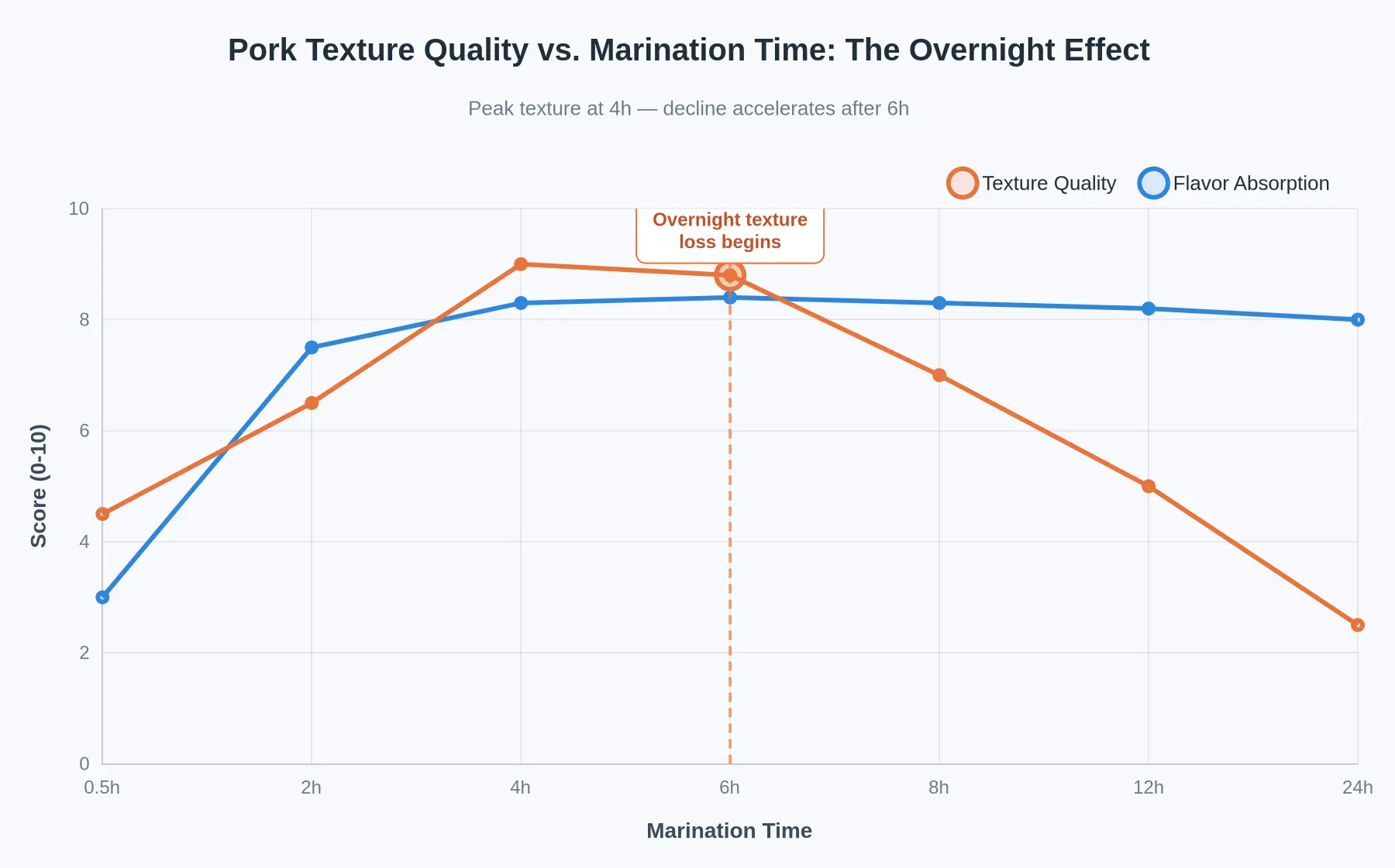
Chart brief
- Title: Pork Texture Quality vs. Marination Time: The Overnight Effect
- Chart type: Two-line line chart (time-series comparison)
- X-axis: Marination Time, plotted at 0.5h, 2h, 4h, 6h, 8h, 12h, and 24h
- Y-axis: Score (0-10)
- Series 1 – Texture Quality (solid orange line): climbs from ~4.5 at 0.5h to a peak of ~9.0 at 4h, stays strong at ~8.8 through 6h, then slides to ~7.0 at 8h and ~5.0 at 12h before collapsing to ~2.5 at 24h
- Series 2 – Flavor Absorption (dashed blue line): rises quickly from ~3.0 at 0.5h to ~7.5 at 2h, then levels off and holds a plateau of roughly 8.0-8.5 from 4h through 24h
- Legend: Texture Quality | Flavor Absorption
FAQ: Guajillo Marinade and Pork Texture
How long should I marinate pork for Al Pastor?
Four to eight hours in the refrigerator. That gives the guajillo chilies, achiote, vinegar, and citrus enough time to penetrate the surface and bloom without pushing the meat past its textural limit. Beyond roughly 12 hours, the acid and enzymes start working against you. If you are short on time, even 2 to 3 hours produces plenty of flavor as long as the pork is sliced thin.
Why does my Al Pastor turn mushy after marinating overnight?
Acid and enzymes break down muscle fibers faster than flavor can develop. Guajillo marinade acidity, especially alongside pineapple’s bromelain and vinegar, denatures surface proteins and weakens the connective tissue that holds the meat together. Leave it too long and the exterior turns soft and grainy, and you lose the springy bite that defines good al pastor. The fix is time management: shorter marination and colder temperatures keep the texture intact.
Does more acid make pork more tender?
Up to a point, yes, but it is not a linear relationship. A moderate amount of acid unwinds protein strands so they hold moisture and feel tender; too much keeps breaking those strands down until the meat turns mealy and waterlogged. Treat acid as seasoning rather than a tenderizing shortcut: enough to enhance, not so much that it dissolves the structure. Balance beats brute force with a guajillo marinade.
How do I fix an over-marinated batch?
If the pork has already gone soft, stop the process, drain the meat, and pat it dry to remove surface acid. Cook it quickly over high heat so it sears and firms rather than stewing in its own liquid, and give it a brief rest in the refrigerator to tighten the texture. For future batches, cut the marinade time and keep the mixture well chilled. There are more technique tips that keep the meat firm and juicy in our Al Pastor taqueria guide.
What is the best acid balance for a guajillo marinade?
Roughly 1 part acid (vinegar or citrus) to 3 parts aromatic base, meaning the chilies, achiote, garlic, and spices carry the flavor while acid supports it. That keeps guajillo marinade acidity subtle enough to brighten the pork without overwhelming its texture. Taste as you blend, since vinegars vary in strength, and remember that too little acid is easier to fix than too much. A balanced marinade smells smoky and fruity, not sharply sour.
Do I need pineapple juice, and does it affect texture?
Pineapple is traditional and adds sweetness and brightness, but it also contains bromelain, an enzyme that speeds up protein breakdown. Use it sparingly and keep the soak short when fresh pineapple juice is involved. Many cooks prefer canned or briefly heated juice, because heat deactivates some of the enzyme while keeping the flavor. Either way, a shorter soak protects the texture.
Should I marinate at room temperature or in the fridge?
In the refrigerator, always – it slows both bacterial growth and enzymatic activity. Cooler temperatures make the marinade work more gradually, which lowers the risk of that mushy, over-processed result. Pair that habit with reasonable timing and you are far more likely to get a tender, well-seasoned batch, whether you are cooking at home or eating out around Al Pastor West Allis.
Does the cut of pork change how long I should marinate?
Yes. Thinly sliced shoulder or butt absorbs flavor quickly and needs only a few hours, while thicker chunks need more time and are more likely to end up uneven. Match the window to the thickness of the cut, and trim the excess fat that slows penetration. The right cut, sliced thoughtfully, matters more for texture than any marinade trick.
The Takeaway: Balance Is Everything
Good al pastor comes from control, not a secret ingredient. Mastering guajillo marinade acidity and knowing when to stop marinating is the difference between pork that is tender and vibrant and pork that is mushy and washed out. Three things to remember:
-
Respect the window. Marinate roughly 4 to 8 hours. That is long enough for the guajillo, achiote, and citrus to penetrate the meat, and short enough to preserve its structure.
-
Understand the breakdown. Acid and enzymes do not just flavor pork; they denature proteins. Push too far, especially overnight, and the fibers dissolve into a soft, mealy texture that no amount of char or pineapple will fix.
-
Prevent, don’t repair. Salt partway through, chill consistently, keep the acid moderate, and pull the pork from the marinade on schedule. Texture is protected before cooking, not after.
Whether you are cooking at home or hunting down the authentic Al Pastor West Allis that locals swear by, hold the same standard: balanced acidity, a disciplined marinating window, and pork that stays juicy without falling apart. Get those right and the results hold up next to what you would find at a standout Al Pastor spot on Court Street.