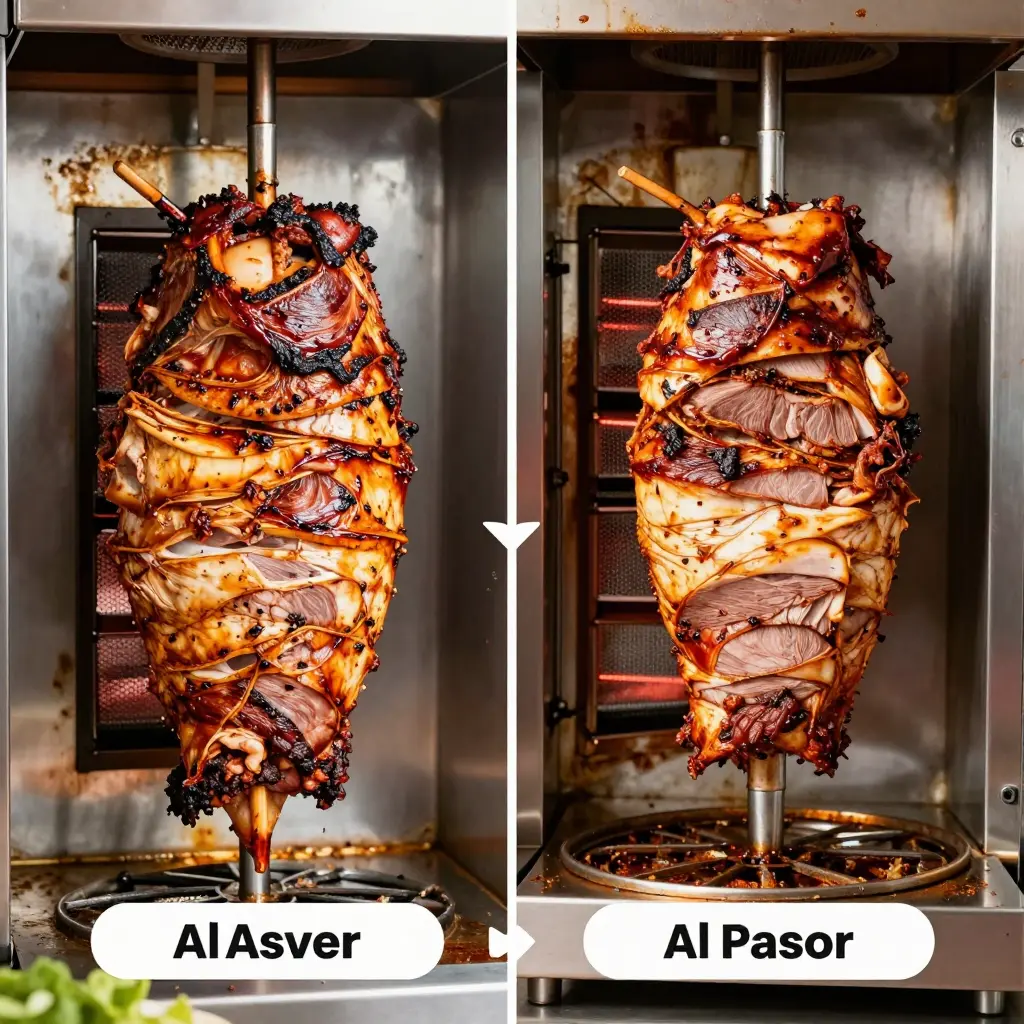
Gas vs. Electric Trompo: The Decision That Shapes Your Al Pastor Operation
A taqueria picks its al pastor vertical broiler early and lives with the choice for years. Gas and electric trompos both hold a stacked cone of marinated pork and turn it against a heat source, but they deliver heat differently, which changes your energy bill, how much control the cook has over the crust, and how much usable meat comes off each cone. That last figure is carve yield, and it sets your food cost per taco.
The trade-off is blunt: a cheaper unit can cost more per serving if it trims or overcooks the cone, while a higher-priced one often earns the difference back through steadier heat and less waste. Anyone comparing a gas vs electric trompo needs total cost of ownership, not the sticker price.
This guide compares:
- Upfront purchase and installation cost
- Heat control, rotation speed, and cooking consistency
- Carve yield and trim loss per cone
- Peak throughput during rush periods
- Energy use, venting, and gas line or electrical requirements
- Maintenance, cleaning, and safety considerations
- Best-fit scenarios, from food trucks to high-volume brick-and-mortar kitchens
For a closer look at how trompo setups fit day-to-day taqueria work, this overview of al pastor trompo configurations is worth reading before you pick a fuel type.
How a Vertical Broiler (Trompo) Works
A vertical broiler roasts meat on a rotating vertical spit beside a concentrated side-mounted heat source, so radiant and convective heat cook the trompo evenly as it turns. In an al pastor vertical broiler, that arrangement builds the conical stack of marinated pork that gets shaved onto tortillas. The geometry and the path the heat takes matter more than raw power, because they decide how much meat you can shave cleanly.
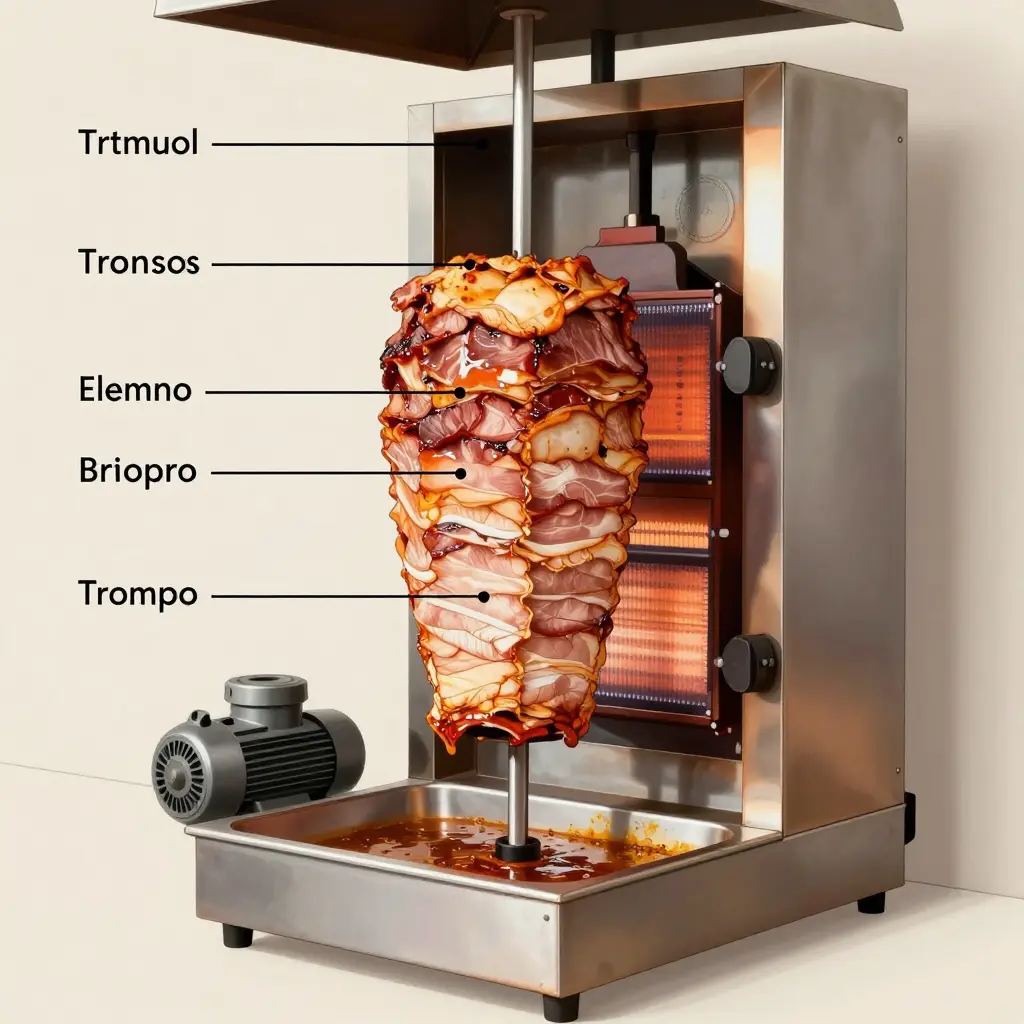
Core Components of a Trompo Setup
- Spit / rod: the vertical steel shaft that pierces and supports the stacked meat and carries rotation from the drive below.
- Heat source: gas burners or electric elements mounted vertically beside the spit, supplying the primary radiant heat.
- Motor: a gear-reduced drive that turns the spit slowly and steadily.
- Drip tray: a base pan that catches fat and juices, protecting the motor and easing cleanup.
- Outer shell / enclosure: the metal housing that reflects heat inward, shields operators, and channels airflow around the column.
The Operating Principle
The stack is built from the base up: thin slices of marinated pork are pressed onto the spit in overlapping layers and compressed slightly so the column holds together as it turns. The cone widens toward the bottom, so the upper layers carry less mass and cook faster.
Heat never comes from directly under the meat. Burners or coils sit to one side, cooking the facing surface mainly by radiation while convection circulates hot air inside the enclosure for secondary browning. Rotation speed decides how long each surface faces the flame. Too slow and the near side chars before the far side is done; too fast and no surface develops a crust, so slices tear and yield drops. Keep rotation slow and constant and every layer browns evenly, which lets the cook shave thin, intact slices. That steadiness is what separates a dependable al pastor vertical broiler from a finicky one, and it is why it pays to see how a working trompo setup performs in practice.
How Gas and Electric Vertical Broilers Actually Deliver Heat
Does a gas-fired broiler cook al pastor differently than an electric one? Yes, and the difference traces to how each machine pushes thermal energy into the stacked pork. Those mechanics drive everything downstream, including operating economics and carve yield.
The diagram below reduces both machines to essentials. On the left, a gas-fired vertical broiler; on the right, an electric one. Both hold the same spit and the same stacked al pastor, and the arrows trace where the heat goes.
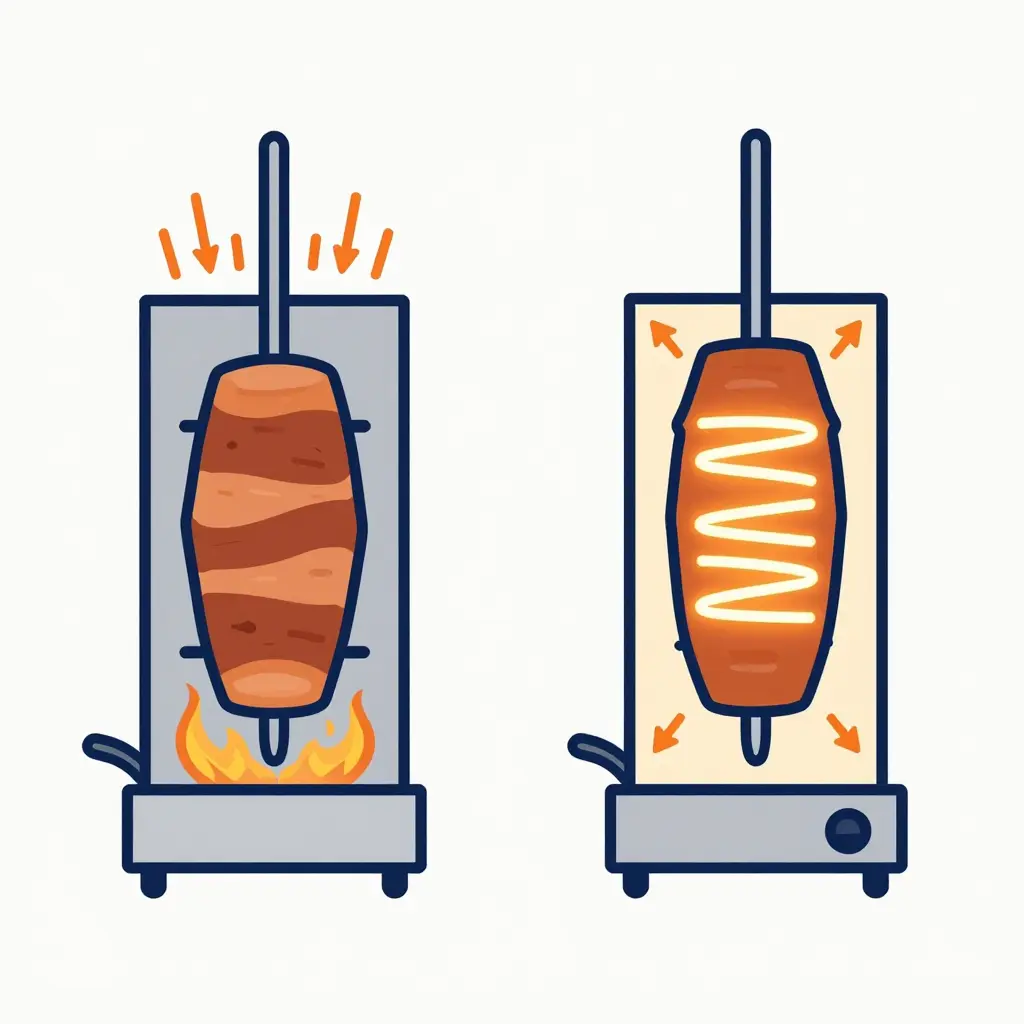
Reading the Diagram
Side by side, the geometry explains itself. Both are radiant-first machines: the meat cooks mainly from energy waves, not from hot air swirling around it. What differs is where that radiant energy starts.
The Gas Side: Combustion and Convection
On a gas-fired vertical broiler, burners at the back of the cabinet ignite into a row of flames. Two things happen at once:
- Radiant heat leaves the flame and the hot refractory surface behind it and strikes the outer layer of the trompo directly.
- Convection carries a column of hot combustion gases upward, curling around the meat and basting the upper and side surfaces.
That produces the crust people associate with al pastor: caramelized edges where the radiant field is strongest, with some combustion character folded in. Gas units also run hotter at the surface, which is why operators chase the flame-kissed finish. Burner placement and cabinet depth vary widely between machines, so it is worth comparing units built around a true vertical trompo configuration if that finish is the goal.
The Electric Side: Coils and Radiant Focus
On an electric vertical broiler, glowing resistance coils or quartz elements replace the flame:
- Radiant heat from the hot coils dominates, and it stays steady and even.
- Convection still happens, but hot-air movement is weaker without combustion gases driving an upward draft.
Electric units therefore give a more uniform surface tan with less of the dramatic char a flame produces. For operators who want consistency, hands-off temperature control, and no gas line, that is often a trade worth making.
Why This Matters for Carve Yield
The heat source shapes how much usable meat leaves the spit. A hot, aggressive radiant field from a gas broiler sets the crust faster, so you can begin slicing thin ribbons earlier in the shift. An even electric field cooks the stack more gradually, narrowing the gap between the crisp exterior and the juicy center. Neither wins on its own; what matters is the match between the machine, your menu tempo, your kitchen infrastructure, and the texture you want in the tortilla.
The Takeaway
Gas buys intensity and combustion character; electric buys steadiness and simplicity. Both push radiant heat into the stacked trompo, but the arrows land differently. Pick the one that matches how your taqueria runs.
Gas Vertical Broiler Performance: How It Actually Behaves in an Al Pastor Operation
A gas vertical broiler is the workhorse of most traditional trompo operations. It gives up the programmable control of an electric unit in exchange for high-output radiant heat and a real char. Knowing how it behaves from ignition to cleanup helps owners and kitchen managers decide whether gas fits their menu volume and building.
Ignition and Heat-Up Behavior
Gas units light fast and climb quickly. Most commercial burners bring the radiant surface to working temperature in roughly 10 to 15 minutes, against 25 to 35 minutes for many electric models. That gap matters during a lunch rush, when the trompo has to be slicing minutes after opening. A cold-start flame can also spike unevenly, so a short pre-heat and a rotation warm-up keep the outer surface from scorching before the interior renders.
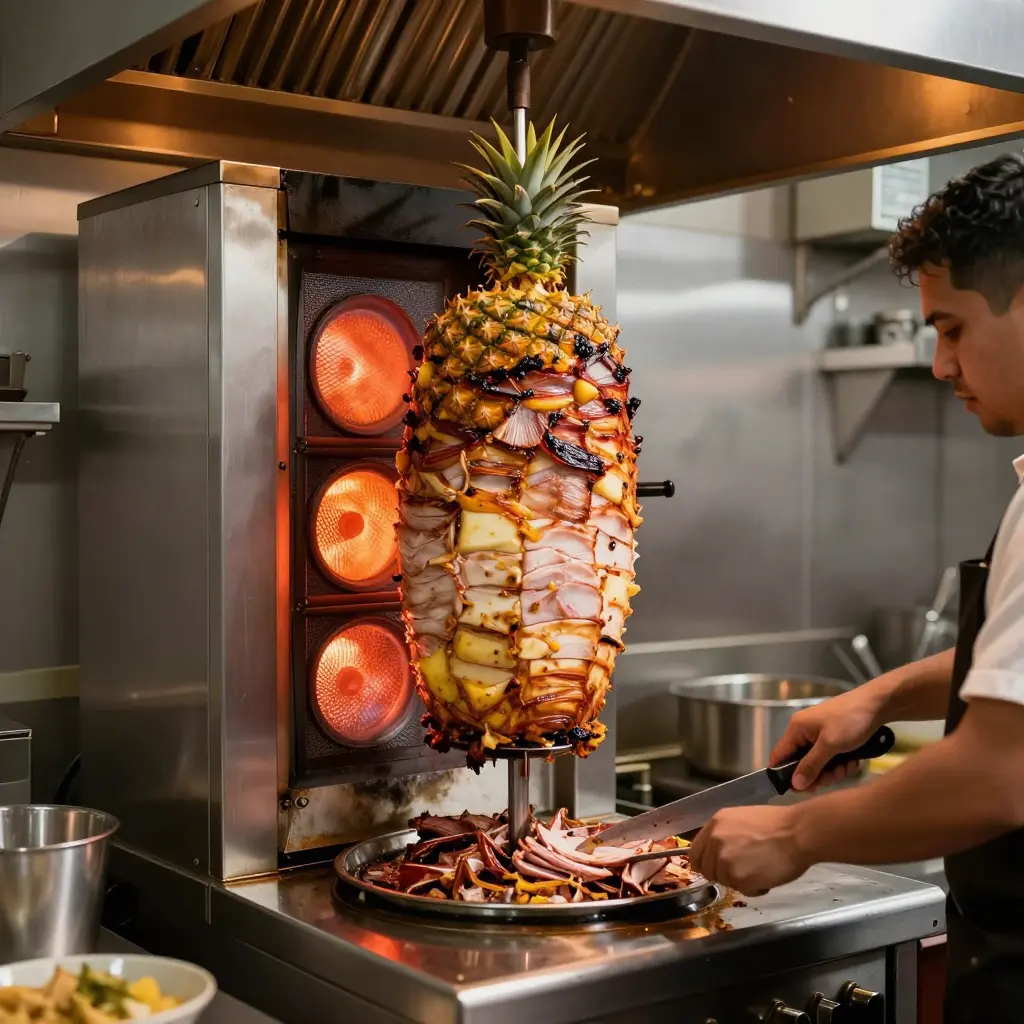
Intensity Control and Radiant Heat Characteristics
Gas flames answer the valve instantly: turn it up and the radiant wall glows hotter within seconds. That responsiveness gives cooks direct command over crust formation, and it also introduces variability. A gas vertical broiler is read from the flame and the meat rather than from a digital setpoint, so consistency rests on staff skill. Radiant energy from a gas burner tends to produce a fast, dry surface char rather than the slower, more even browning of an electric element.
Flavor Development Through Charring
This is where gas has the edge for al pastor. Direct flame and intense radiant heat caramelize the marinade (achiote, chile, pineapple) and render fat quickly, producing the crispy, slightly smoky edges that define trompo flavor. Fat dripping from the upper layers bastes the ones below, adding depth that a gentler electric element has a harder time matching.
Ventilation and Installation Requirements
Gas demands infrastructure. Combustion produces heat, moisture, and byproducts, so a properly sized commercial hood with adequate CFM and make-up air is not optional. Gas lines, shut-off valves, and clearance from combustibles must meet local code. Electric units need only power and far less exhaust capacity. That ventilation burden is the main reason some operators choose electric even when they prefer the flavor gas produces.
Typical Maintenance Needs
- Burner orifices and ports require regular cleaning to prevent uneven flames.
- Gas connections and hoses need periodic leak checks.
- The radiant wall and drip tray collect carbonized fat and must be degreased frequently.
- Rotisserie motor and spit bearings benefit from scheduled lubrication.
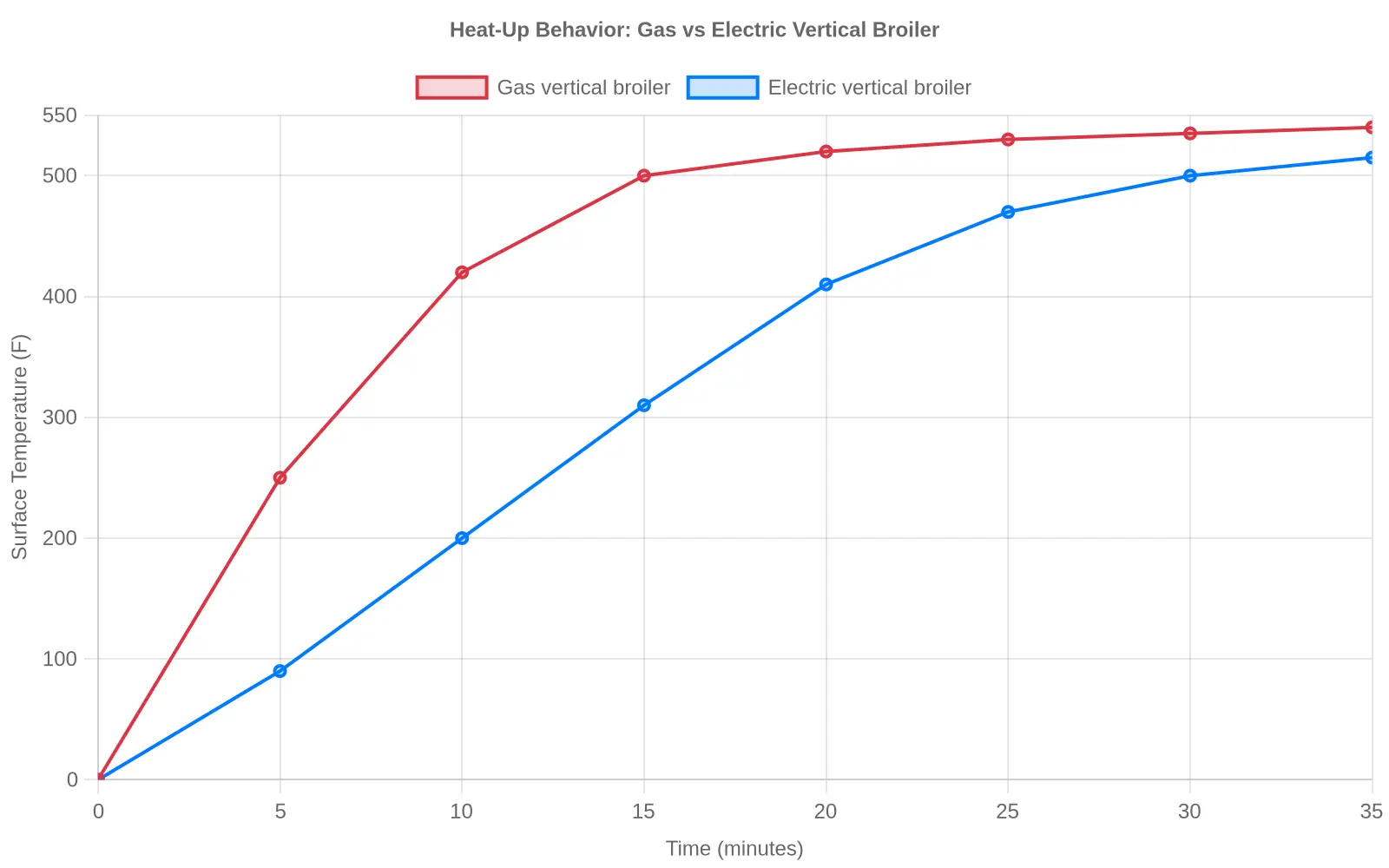
Ramp speed is the visible difference above: gas reaches 500F in about 15 minutes, electric in roughly 30, which is why high-volume taquerias lean gas.
Gas Vertical Broiler: Pros and Cons
Strengths
- High radiant heat output and rapid heat-up for fast service.
- Instant, responsive intensity control for crust and char.
- Superior flavor development through direct flame charring.
- Authentic trompo texture and smoky edge alignment with traditional al pastor.
Limitations
- Significant energy loss to ambient heat and exhaust.
- Demanding ventilation, gas line, and code requirements.
- Greater temperature variability that depends on operator skill.
- Higher ongoing cleaning and burner maintenance load.
For operators weighing the al pastor trompo near me experience their customers expect, the deciding factor is usually whether the kitchen can support gas ventilation. Where it can, the trompo setup returns higher output heat and a genuine char that shapes both flavor and carve yield.
How an Electric Vertical Broiler Performs in an Al Pastor Operation
An electric vertical broiler swaps the open flame for resistance or infrared elements that radiate heat onto a rotating stack of marinated pork. The physical principle is unchanged: a vertical spit turns the cone so every layer meets a controlled heat source, crisping the outside while the interior stays juicy. What changes is how that heat is generated, tuned, and recovered, and those differences drive layout, ventilation, and labor as much as they drive flavor.
Heating element types
- Sheathed tubular (calrod) elements – the workhorse design; durable, moderate radiant intensity, and easy to replace.
- Quartz tube elements – faster to reach temperature and more radiant per inch, but more fragile in a busy line.
- Ceramic infrared emitters – the most even and controllable glow, though they carry the highest unit cost.
Most commercial units pair one or two banks of elements with a fixed or adjustable baffle to angle radiant heat toward the meat.
Warm-up, control, and consistency
Electric units generally warm up more slowly than gas, because the elements must heat a much larger thermal mass before they radiate effectively. Expect roughly 25 to 35 minutes to full glow, against 10 to 15 minutes for gas at comparable output.
The payoff is precision. Solid-state controllers hold set temperatures within a few degrees, so the trompo surface crisps predictably instead of fluctuating with a flame. That stability tends to lift carve yield, since a steady heat profile trims less meat and keeps thin shavings intact. Recovery after a heavy carve is the weak point: the coil has to reheat before full radiant intensity returns, which takes longer than gas.
Ventilation, installation, and operating trade-offs
With no combustion, an electric trompo produces no flue gas and far less ambient heat, which lowers the ventilation burden and can simplify make-up air and hood requirements. No gas line means more installation flexibility for food trucks, kiosks, and tight kitchens. The limits are real: higher connected electrical load, slower recovery, and generally lower peak radiant intensity than an open flame. Weigh those against your menu volume and the al pastor trompo near me configurations available in your market before committing.
| Factor | Electric vertical broiler | Gas vertical broiler |
|---|---|---|
| Warm-up | Slower (25-35 min) | Faster (10-15 min) |
| Temperature control | High precision | Moderate |
| Ventilation burden | Lower | Higher |
| Peak radiant intensity | Lower | Higher |
| Recovery after carve | Slower | Faster |
Gas vs. Electric Vertical Broilers: The Core Trade-Offs
Once you have committed to a vertical broiler, the next fork is the heat source. A gas trompo and an electric trompo can put the same taco on the pass, but they behave differently on the line, from how fast they reach temperature to the char they put on the meat. Weigh the criteria that drive daily operation before signing a purchase order.
Caption – Table 1. Gas vs. electric vertical broiler comparison for taqueria al pastor trompo operations.
| Decision Criteria | Gas Vertical Broiler | Electric Vertical Broiler |
|---|---|---|
| Heat-up time | Fast; typically 10-15 minutes to full broiling temperature | Slower; often 25-35 minutes as elements and chamber reach set point |
| Peak heat intensity | Very high with an open flame; excels at rapid surface searing | Moderate; radiant elements rarely match a live flame’s peak output |
| Temperature control precision | Manual or thermostatic; can drift with drafts and load changes | Tight digital control, often holding within a few degrees of set point |
| Ventilation requirements | Requires a robust Type I hood and regular grease-duct cleaning | Lower exhaust demand; some models can run on a lighter Type II hood |
| Energy source and operating cost profile | Natural gas or LP; cheaper per unit of heat where gas is available | 208-240V electric; higher per-unit energy cost but no gas line or tank |
| Installation constraints | Needs a gas supply, shutoff valve, and code-compliant venting | Needs a dedicated high-amperage circuit; no gas infrastructure required |
| Maintenance | Burner, orifice, and igniter upkeep plus periodic flame tuning | Element and control-board replacement; fewer combustion parts to service |
| Flavor/char development | Superior caramelization and smoky char from direct flame contact | Good browning with drip-on-element sizzle; less smoke character overall |
| Typical fit for different operation sizes | High-volume taquerias, propane food trucks, and char-driven menus | Smaller kitchens, malls, electric-only buildings, and low-ceiling spaces |
Takeaway: Choose gas when peak char and volume drive your menu, and electric when installation simplicity, precise control, and ventilation limits matter more.
How to Decide for Your Kitchen
The right call comes down to the utilities your building has, the ticket volume you expect, and how much you value open-flame char. A high-throughput operation chasing crisp edges will almost always lean gas. A compact or electric-only space usually gets more from precise, low-fuss electric heat. If you want to see how these setups perform on the line, look at a working al pastor trompo near you inside a busy taqueria before you commit the capital budget.
Defining Carve Yield for Al Pastor Operations
Carve yield is the ratio of usable shaved meat to the total stacked weight on an al pastor vertical broiler: how much of the pork you loaded onto the trompo actually reaches the plate. Load 20 kilograms, shave off 14 kilograms of clean, servable slices, and carve yield is 70 percent. The other 30 percent leaves as trim, char, drippings, and unusable crust.
You paid for every kilogram, so the number matters. A low carve yield raises cost per taco, squeezes margin, and pushes you to shrink portions or raise prices just to break even. A high yield stretches the same inventory across more servings without touching the menu price.
Several variables move carve yield up or down:
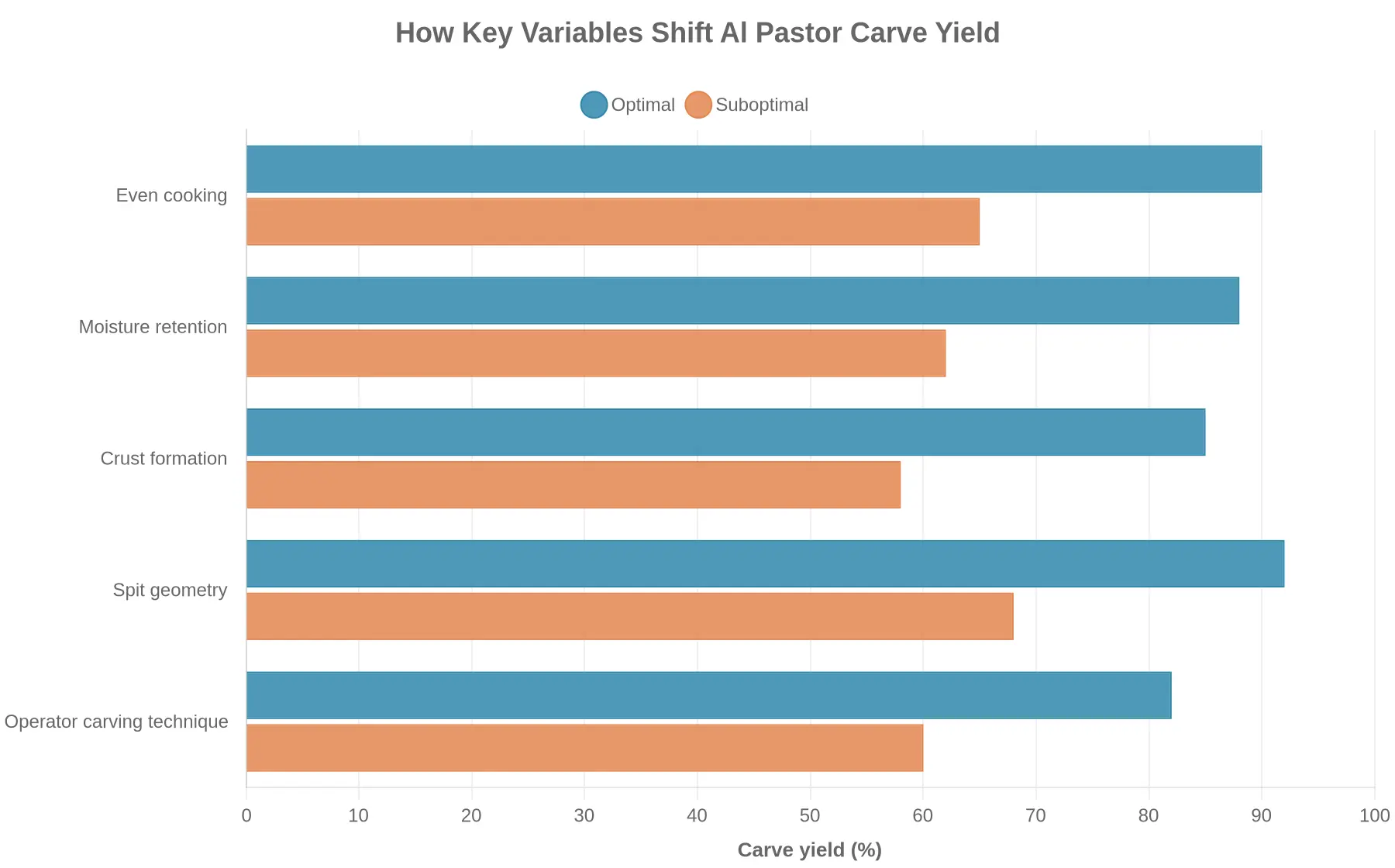
- Evenness of cooking. If one side of the trompo cooks faster than the other, you either serve uneven meat or carve away partly raw sections. Consistent heat keeps the whole cone shave-ready at once.
- Moisture retention. Dried-out meat crumbles instead of slicing cleanly, so it falls off the knife as waste rather than landing in the tortilla.
- Crust formation. A thin, caramelized edge adds flavor and structure. A thick, burnt shell becomes nothing but trim.
- Spit geometry. Diameter, taper, and stacking height decide how evenly heat reaches the core and how cleanly the blade travels down the cone.
- Operator carving technique. A steady hand with a thin, angled slice recovers far more meat than rushed, deep cuts.
This is where the gas-versus-electric decision becomes concrete. Gas broilers deliver intense, adjustable radiant heat and a visible flame that sets the crust quickly, which can lift carve yield when someone is watching it and over-char the cone when no one is. Electric broilers hold a steadier, more uniform surface, which promotes even cooking and consistent shaving through a rush. Neither wins automatically; the result depends on how well your kitchen controls heat, timing, and technique. To see how different traditional al pastor trompo setups handle the trade-off, compare real configurations before you commit.
The chart below shows how each variable shifts carve yield under optimal versus suboptimal conditions.
How Fuel and Configuration Shape Carve Yield
Carve yield is the share of a raw trompo’s weight that reaches the plate as sellable al pastor. The detail stops feeling minor once you run the math across hundreds of trompos a week, where a few percentage points of loss eat into margin. The chart below compares typical outcomes across four common vertical broiler setups.
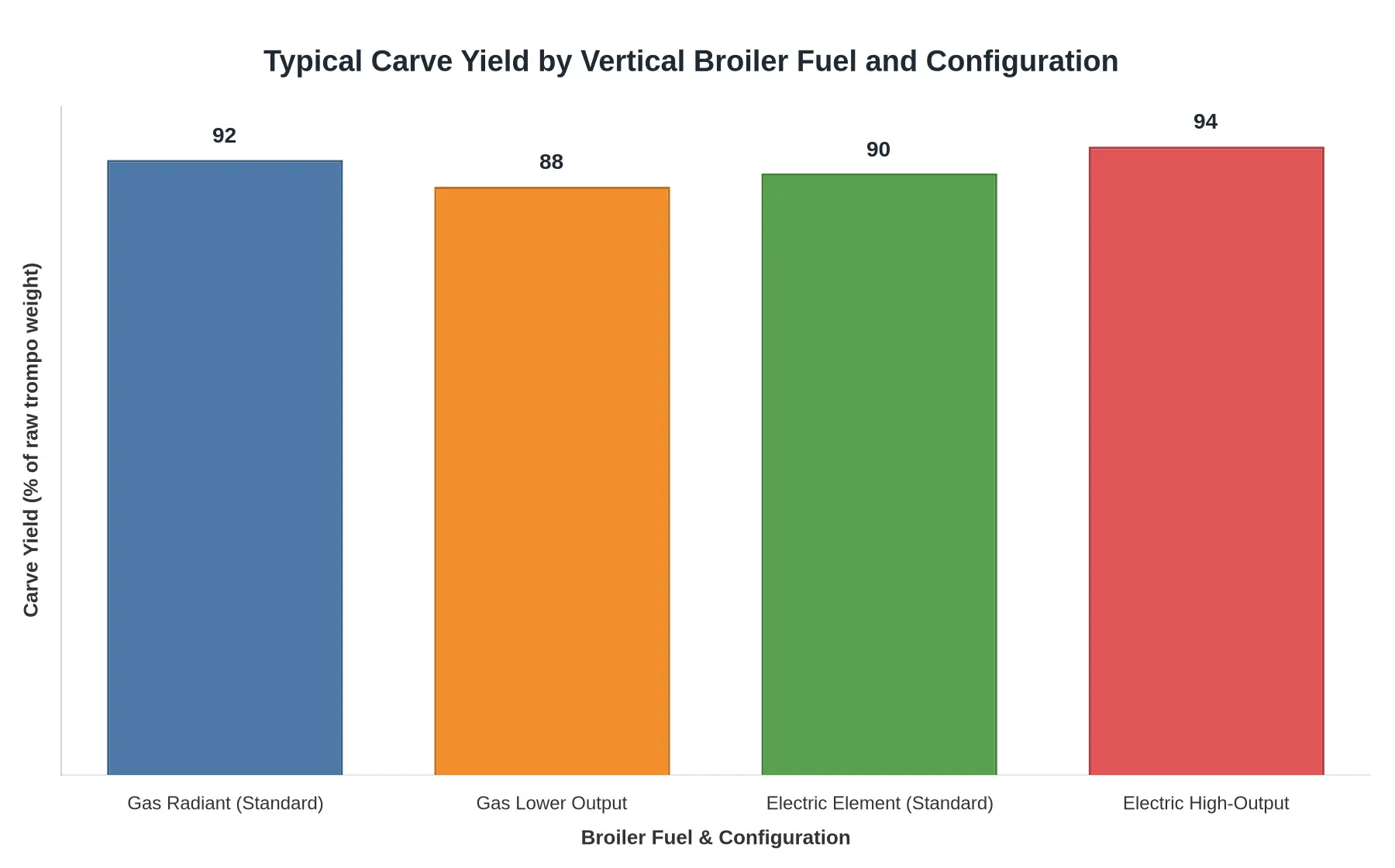
Figure: Typical carve yield percentages across illustrative vertical broiler fuel and configuration choices, expressed as a share of raw trompo weight.
The pattern: more consistent heat control means less shrinkage and waste, which puts the electric high-output setup and the standard gas radiant configuration at the top of the range and the lower-output gas unit behind the pack. That several-point gap between best and worst is often the difference between a profitable Friday night and a break-even one, so the choice depends on your volume and workflow as much as on fuel type.
Operational and Equipment Factors That Shape Carve Yield
Two taquerias can run the same trompo and still carve different amounts of usable meat. The gap usually comes down to a few controllable variables:
- Meat marinade and stack density – A wetter, heavier marinade adds weight and moisture, while how tightly the pork is compressed onto the spit determines how evenly heat penetrates the cone and how cleanly slices release.
- Spit rotation speed – Consistent rotation keeps the exterior browning evenly; too fast and the surface never sears, too slow and one side overcooks, blackens, and burns off valuable yield.
- Heat source type and intensity – Gas delivers fast, adjustable radiant heat, while electric elements provide steadier, more uniform output, each reshaping how much meat must be trimmed away as waste.
- Distance between heat and meat – A wider gap protects carve yield by preventing overcooking, but too wide a gap stalls caramelization and slows service during a rush.
- Carving timing and technique – Slicing at the peak of doneness with a smooth, decisive stroke reduces the crumbling and off-cuts that erode usable meat.
- Resting time – A brief rest lets juices redistribute through the roast, so less moisture is lost on the cutting board.
- Moisture retention – Retaining juices through controlled heat and quick carving keeps portions plump and protects both flavor and plate weight.
When buyers weigh gas against electric, each factor above is a trade-off rather than a fixed win. Gas generally offers faster recovery and higher peak heat, which rewards careful stack density and carving timing during peak hours. Electric models deliver more repeatable, even heat that makes spit rotation and heat distance easier to standardize. Rank the factors by your own volume and menu, then pick the commercial al pastor trompo setup whose strengths match your busiest nights.
Operating Cost and Throughput: Gas vs. Electric Vertical Broilers
Upfront price is the visible number, but operating cost and throughput decide whether a vertical broiler pays for itself. Over a six-hour dinner service, energy, idle losses, and maintenance quickly outweigh the sticker-price difference between gas and electric.
Energy Consumption Patterns
A gas vertical broiler delivers heat through radiant and convective combustion, and its burners draw energy steadily across the cook cycle. An electric vertical broiler converts nearly all input electricity into heat at the elements, but utility rates and demand charges decide what that efficiency costs in dollars. Gas usually wins on cost per unit of heat where supply is cheap; electric often wins where rates are stable and ventilation infrastructure is limited.
Start-Up and Idle Energy Use
Start-up behavior shapes labor and prep. Gas trompos reach searing temperature faster, which suits operators who fire up shortly before service. Electric units need a longer ramp but hold temperature precisely, so they run efficiently through slow stretches with minimal cycling losses. During a quiet afternoon, an electric element that idles cleanly can cost far less than a gas burner kept lit to avoid reheat time.
Throughput, Carve Yield, and Service Speed
Throughput is finished product per hour, and it interacts directly with carve yield. A broiler that cooks evenly and consistently produces a higher carve yield, because less meat is lost to uneven shaving, charring, or overcooking. Higher throughput also shortens the wait for a carved trompo to reach the line, compressing ticket times at peak. The bottleneck is rarely the broiler itself; it is the balance between cook rate, carving cadence, and how fast staff can shave portions.
Maintenance and Long-Run Cost
- Gas units need gas lines, hoods, and venting, plus periodic burner and valve servicing.
- Electric units avoid combustion infrastructure and typically carry lower ongoing servicing.
- Both require trolley, skewer, and motor upkeep; grease management is identical.
- Higher carve yield compounds savings over hundreds of servings, not single tickets.
Model five-year cost of ownership rather than the invoice, and weigh peak-hour output against your real service speed. For operators checking how throughput fits their menu build, reviewing al pastor trompo examples can clarify practical volume expectations.
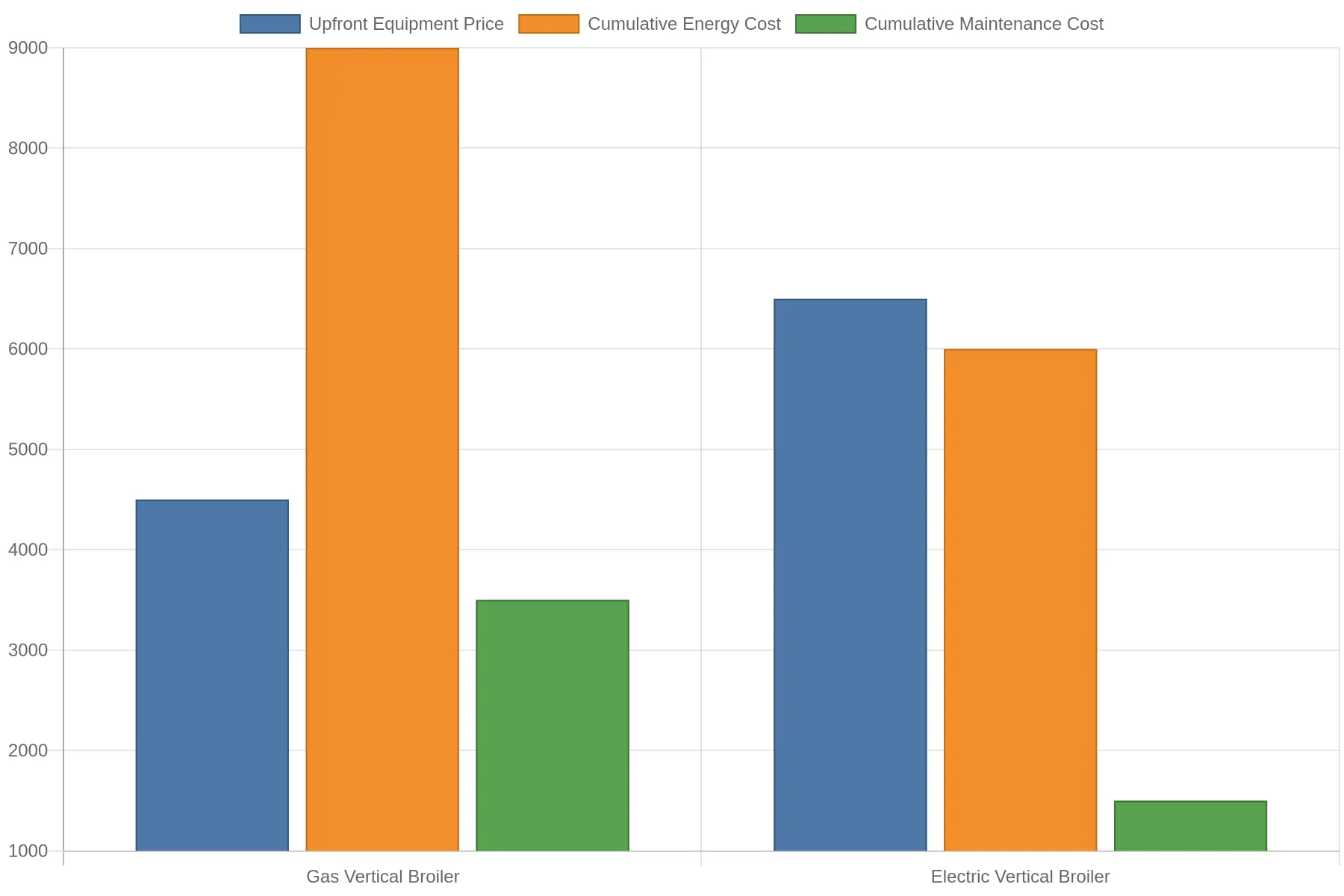
The chart above frames the trade-off: electric carries a higher upfront cost but narrows the gap through lower energy and maintenance, while gas front-loads savings and concentrates expense in energy and upkeep.
Frequently Asked Questions: Gas vs. Electric Vertical Broilers and Carve Yield
Does an electric trompo produce authentic al pastor char?
It can, within limits. Al pastor character comes from direct radiant heat caramelizing the outer layer of the marinated pork, and a well-designed electric vertical broiler reaches and holds the surface temperatures needed for a crisp, mahogany-colored crust. The work is in dialing element output against rotation speed so the cone sears on the outside while staying juicy inside. A tuned electric unit can match the crust of a flame, though it will not reproduce the smoke character of combustion.
Which fuel type yields higher carve yield?
Technique and equipment tuning matter far more than fuel type. A gas vertical broiler and an electric vertical broiler can reach comparable carve yield when heat is even and the trompo is trimmed correctly. Gas can sear harder, which helps shave thin, high-value slices with minimal waste; electric holds steadier low-zone heat, which reduces overcooking and shrinkage. The operator who manages rotation, distance from the heat source, and slicing angle usually wins the yield battle.
What ventilation does a gas vertical broiler require?
Gas combustion produces heat, moisture, and byproducts, so a gas vertical broiler needs a code-compliant exhaust hood with adequate capture velocity and make-up air. In practice that means a properly sized hood, grease filtration, and enough airflow to move smoke and fumes away from the unit and the staff. Confirm local mechanical codes and hood ratings before installation; undersized ventilation hurts both performance and air quality.
Can an electric vertical broiler handle peak-hour volume?
Yes, if the unit is sized for your throughput. Modern electric vertical broilers hold temperature well, and with enough element wattage and spits you can keep multiple cones rotating through a rush. Recovery is slower than gas after a heavy carve, so high-volume taquerias often choose a higher-output model and stage backup cones to keep pace with demand.
How do I maximize carve yield regardless of fuel type?
Work the fundamentals. Trim the pork consistently, marinate evenly, and pack tight, uniform cones so heat penetrates predictably. Keep rotation steady, slice only the caramelized outer layer, and let the trompo re-crisp between passes instead of cutting into raw meat. Sharp blades, a consistent slicing angle, and close temperature monitoring prevent over-rendering. To see how a professional al pastor trompo setup is dialed in, review proven configurations before you commit to a fuel type.
The Decision Framework: Matching Fuel Type to Your Operation
After all the variables, the gas vs electric trompo decision usually comes down to four filters: ventilation capacity, required output volume, temperature-control precision, and carve yield priority. Score your operation against each, then let the dominant constraint drive the purchase. The flowchart below shows how those filters sequence into a recommendation.
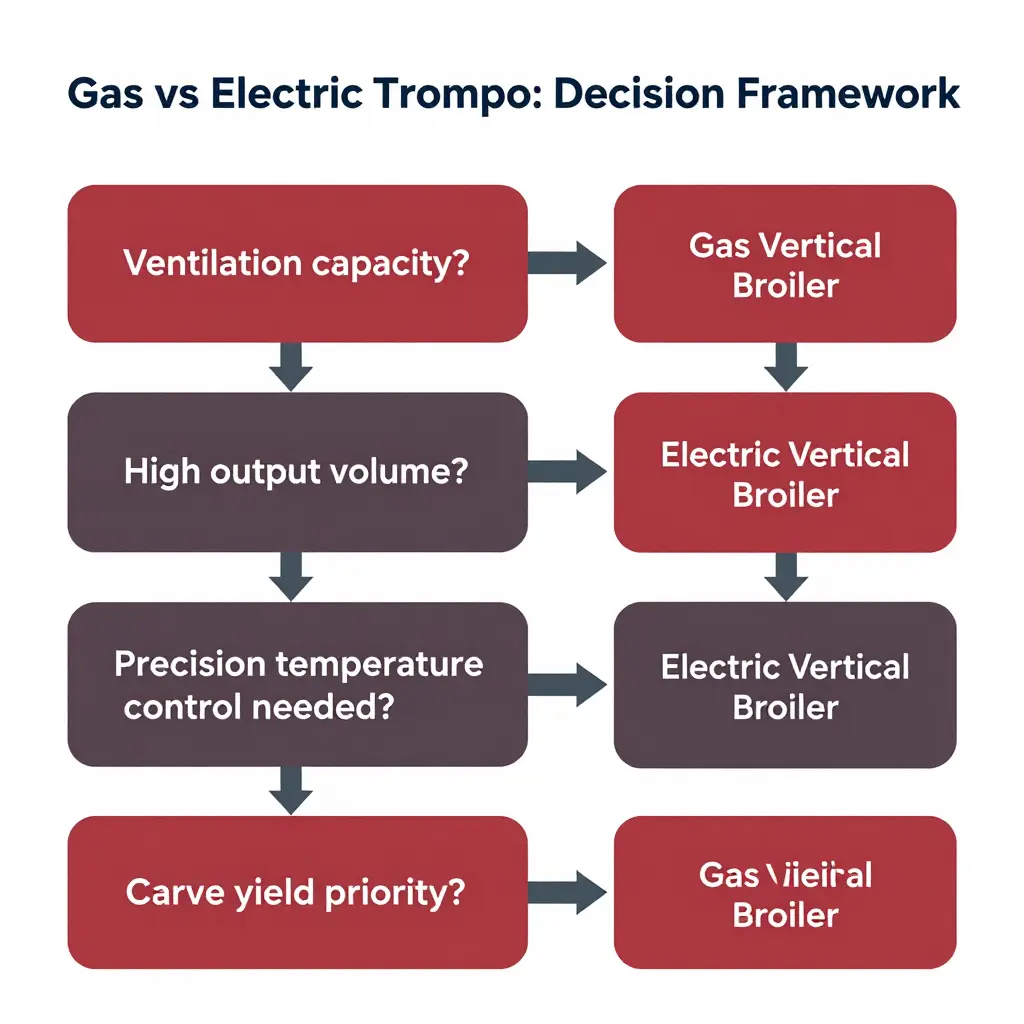
How the four filters guide the choice
Ventilation. A gas al pastor vertical broiler needs a Type I hood, dedicated make-up air, and gas-line clearance, so it only makes sense where the build-out already supports it. Electric units run on standard power and suit compact kitchens, food trucks, and leased spaces with limited hood capacity.
Output volume. High-traffic taquerias firing hundreds of tacos per service benefit from the faster recovery and sustained heat of gas. Lower-volume operations rarely saturate an electric trompo and can save on installation and permitting.
Temperature control. Electric elements hold steadier, more repeatable surface heat with digital setpoints. Gas produces intense radiant heat that needs more active adjustment to avoid hot spots.
Carve yield. Fuel does not change the meat, but it changes the heat profile, and the heat profile decides carve yield. A consistent, evenly distributed heat source leaves less trim, so more of each cone becomes sellable meat. That is the tiebreaker when two systems otherwise perform alike.
Decision matrix
| Operation priority | Recommended system | Rationale |
|---|---|---|
| Maximum carve yield through steady cone heat | Electric (preferred) | Digital set-points reduce hot spots and trim loss |
| High sustained output during peak service | Gas (preferred) | Faster recovery and intense radiant heat |
| Limited hood or ventilation build-out | Electric | Standard power, minimal exhaust demand |
| Established gas line and full commercial hood | Gas | Lower operating cost at high volume |
Recommendations by operation type
- Higher-volume taquerias (300+ tacos per service): choose gas for peak-hour throughput, and protect carve yield with disciplined carving height and rotation.
- Lower-volume or peak-limited operators: choose electric to control cost and simplify installation without sacrificing output.
- Food trucks and limited-power sites: choose electric, since it avoids gas-line and exhaust constraints entirely.
- Specialty al pastor houses optimizing carve yield: prioritize cone-heat consistency over raw power, then match burner height to the cone.
- Hybrid and expanding kitchens: start electric, add gas once volume justifies the hood investment.
Ventilation and output volume push most operators toward a fuel type; temperature control and carve yield confirm the final call. A system aligned with your real service pattern lowers cost per taco and raises carve yield over every shift. You can see how established kitchens apply these criteria across real-world al pastor trompo setups.