
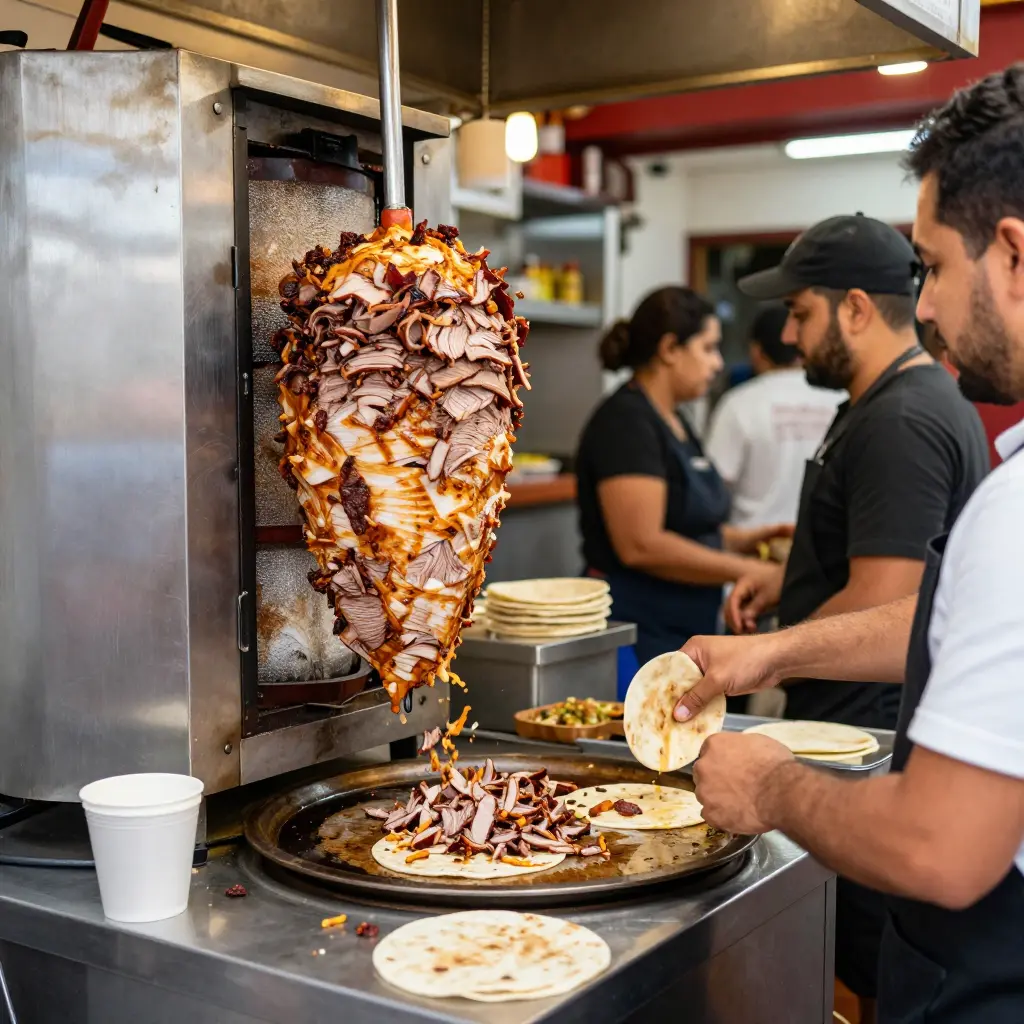
What an Al Pastor Trompo Is
Walk into a busy taqueria at noon and you will see it behind the counter: a tall cone of pork turning on a vertical spit. That is the al pastor trompo — thin sheets of pork marinated in chili and achiote, stacked on the spit and often topped with a pineapple that drips down the stack as it rotates. The name is Spanish for “spinning top,” and the shape is why. It is a cooking method, but it also works like a machine: how fast it turns and how often the taquero shaves it sets the pace for everything downstream. Seeing one up close takes only a short trip — it is easy to spot a real al pastor trompo near you.
How the Vertical Spit Rotates
A burner, gas or charcoal, sits to one side of the spit, and a motor turns the stack slowly, usually just a few rotations per minute. The heat caramelizes the outer surface into crisp, browned edges while the inside stays juicy. The taquero shaves those browned layers with a long knife; the slices fall onto a waiting tortilla, and the newly exposed meat rotates back toward the fire to crisp again. That trim-and-crisp cycle is the whole mechanism: the spit keeps producing a fresh surface.
Why Trompo Timing Controls Throughput
At lunch, a well-stacked, well-cooked trompo is a ready supply of fast, portionable protein. One that is too thin, over-charred, or lit ten minutes late becomes the bottleneck instead. When the shave slows, the tortilla station stalls, orders pile up, guests wait, and the line jams. Timing the trompo is not a minor kitchen detail; it is the throttle on the entire service.
Takeaway: stack it well and start it early. The rhythm of the spit sets the pace for every order after it.
How often you rotate and slice changes dramatically with order volume, so matching the two to the lunch-rush tier keeps the pastor flowing and the ticket rail under control. For a closer look at how the spit itself shapes service speed, see how a well-tuned al pastor trompo anchors a busy taqueria line.
| Order Volume Tier | Recommended Trompo Rotation & Slicing Cadence | Staffing Adjustment | Expected Effect on Ticket Backlog |
|---|---|---|---|
| Light (under 40 tickets/hr) | Slow rotation; slice to order in single 3-4 cm passes, re-sear edges every 5-6 min | 1 taquero on the trompo, 1 expeditor | Minimal backlog; keep 2-3 pre-cut portions warm as buffer |
| Moderate (40-80 tickets/hr) | Steady rotation; slice pre-portioned 4-5 cm shavings every 2-3 min into a holding tray | Add 1 dedicated slicer, cross-train a floater for restocks | Backlog peaks stay under 4 min; holding tray absorbs sudden rushes |
| Heavy (80-140 tickets/hr) | Fast rotation; continuous shaving every 60-90 sec aimed at the hottest top layer | 2 slicers (one trims, one plates) plus a trompo refill runner | Backlog flattens near zero per station; tickets pushed within 6-8 min |
| Extreme (140+ tickets/hr) | Maximum rotation; pre-cut high-volume batches every 45-60 sec, refresh pineapple and marinade on schedule | 3+ slicers on staggered shifts, dedicated QC on shaving thickness | Sustained throughput; backlog only spikes if the trompo runs low mid-rush |
Treat these tiers as guardrails, not fixed rules. The moment the shaving tray runs dry, the trompo stops and the backlog climbs, so the real discipline is syncing rotation speed and slicing cadence to the pace your kitchen can actually plate.
Root Causes of Ticket Backlog During the Lunch Rush
The main driver of a ticket backlog at a taqueria is not slow staff. It is a throughput mismatch between the trompo and the order line: during a lunch rush, a single al pastor trompo can slice only so many tacos per minute, and when orders arrive faster than the spit can shave, the gap becomes a queue.
Three bottlenecks show up repeatedly at busy counters.
- Trompo throughput limits. A loaded trompo yields a fixed number of servings per rotation. If the fire runs low or the meat is stacked too thickly, slicing slows and every taco waits. Knowing how a properly built al pastor trompo works helps set a realistic servings-per-minute ceiling.
- Station bottlenecks. Even with meat ready, the tortilla warmer, salsa bar, and packaging station each handle a set volume. When one stalls, the line backs up behind it.
- Order sequencing errors. Dumping tickets in strict arrival order, instead of grouping them by protein, forces the cook to reset grill space and tools repeatedly.
When slicing lags behind order intake, backlog compounds: late tickets push new orders further back, the grill and warmer jam, and the whole line slows. A slicing delay early in the rush is not paid back later; it propagates through every ticket behind it.
The practical answer is to balance trompo output against order intake through pre-staging and grouped sequencing, rather than adding staff to a line that is already jammed.
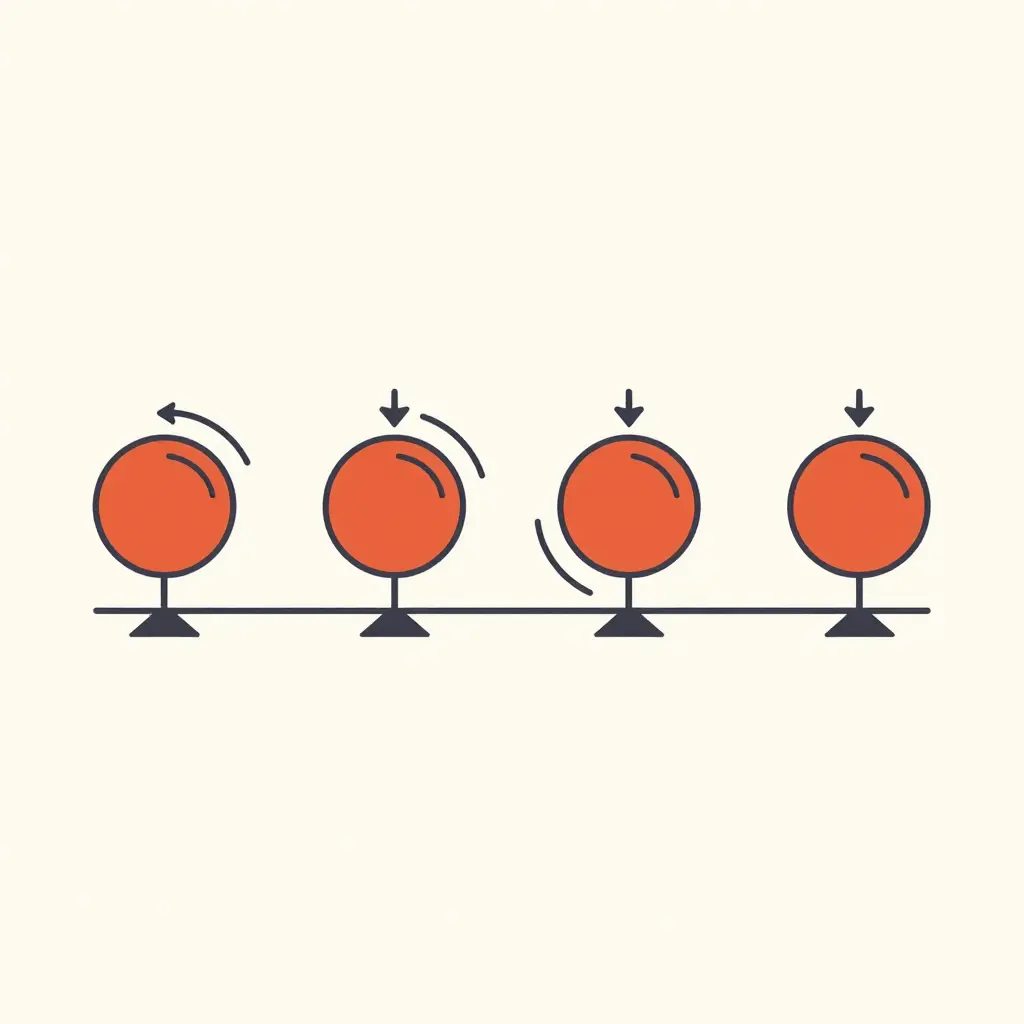
The diagram above maps the cycle as a repeating loop. Each circle is the spit at one moment, the curved arrows show its steady rotation, and the wedges mark where the blade meets the spinning surface. Read left to right, it is rotate, slice, rotate, slice — the rhythm a smooth lunch rush runs on.
Why the Rotation Rhythm Matters
Once you read the cycle as a timeline rather than a single motion, timing becomes something you plan around instead of react to.
- Rotation speed sets how quickly fresh, caramelized edges reach the blade.
- Slice intervals determine how many tacos you can plate per minute without the meat drying out.
- The repeat loop is what lets a busy counter keep pace with a backlog of tickets.
Treating the trompo as a clock rather than an appliance is the first step toward keeping orders moving. For a closer look at how a well-timed setup translates into faster service, see how a well-run pastor taqueria structures its line.
Reading the Cycle at a Glance
| Phase | Motion | What Happens |
|---|---|---|
| 1 | Rotate | Heat builds on the outer layer, crisping the edges |
| 2 | Slice | Blade shaves the ready layer into thin, even pieces |
| 3 | Repeat | The spit turns again, exposing a fresh surface |
Once this loop is second nature, the team stops guessing and moves with the grill.
Synchronizing Trompo Readiness with Lunch-Rush Peaks
Al pastor trompo timing begins long before the first customer walks in. The vertical spit carries a large thermal mass, so it needs a head start. Most kitchens fire the trompo and bring it to full rotation roughly 45 to 60 minutes before the expected rush, giving the outer layers of pork time to caramelize and develop the crisp edges that define good al pastor. Start too late and the meat is pale and under-rendered; start too early and it dries out before demand arrives.
Marinade and stack preparation are just as time-sensitive. The pork should spend at least several hours, ideally overnight, in a guajillo and achiote marinade so the seasoning penetrates evenly. When you stack the meat, aim for a compact, evenly tapered cone that cooks at a consistent rate from base to tip. Prepping two or three backup cones and keeping them chilled lets you reload the spit without interrupting service.
Base the start time on your own sales data. If the peak lunch hour reliably lands between noon and 1:30 p.m., back-calculate so the first carve is ready ten minutes before that window opens. The ticket backlog is the real-time signal: if printed tickets start clustering and the kitchen is waiting on the trompo, the start time was too conservative; if trays of carved meat sit idle, it was too aggressive. Staff at a trusted al pastor trompo near me location track these patterns daily, and the same discipline applies whether you run a single spit or a full taqueria al pastor operation. Adjusting by 15-minute increments each week keeps the trompo, the marinade, and the lunch crowd in balance.
The data below shows the shape of the crunch. Backlog climbs through the late morning, peaks at 12:30 p.m., then falls off as the trompo line catches up.
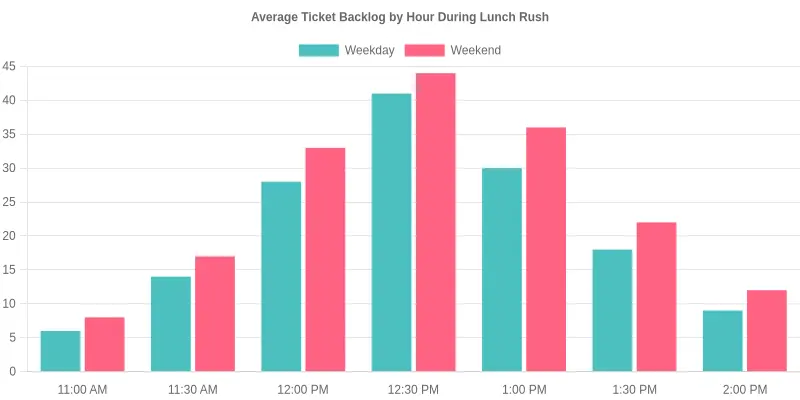
What the Bars Tell You
| Hour | Weekday Backlog | Weekend Backlog |
|---|---|---|
| 11:00 AM | 6 | 8 |
| 11:30 AM | 14 | 17 |
| 12:00 PM | 28 | 33 |
| 12:30 PM | 41 | 44 |
| 1:00 PM | 30 | 36 |
| 1:30 PM | 18 | 22 |
| 2:00 PM | 9 | 12 |
Between 11:30 a.m. and 12:30 p.m., a weekday backlog roughly triples, from fourteen tickets to forty-one, and the same hour on weekends pushes past forty-four. This is the stretch where trompo timing either saves the service or sinks it. Turn only one cone through this window and the backlog grows faster than you can slice. For a kitchen trying to flatten that curve, understanding how a well-managed trompo keeps tickets moving is the difference between a rush you control and a rush that controls you.
When the lunch crowd hits, the difference between a smooth line and a jammed one usually comes down to a handful of deliberate tweaks.
- Stagger al pastor prep so a fresh trompo is spinning before the previous one runs out, keeping the spit productive instead of idle at peak demand (see our guide to al pastor trompo near you).
- Calibrate the vertical broiler’s heat and rotation speed so every cone reaches optimal caramelization inside a predictable window.
- Assign a dedicated taquero to the trompo during the rush so al pastor orders never wait behind other proteins sharing the same station.
- Batch-fire tortillas and pre-portion garnishes ahead of the wave so assembled al pastor plates move faster and the backlog stops snowballing.
- Trim the lunch menu to the highest-velocity items and cut slow sellers that clog the line.
- Put a runner on completed orders and the pass so the expo station stays clear.
- Pre-stage salsas, limes, and garnish cups at the counter so al pastor tacos can be handed off the instant the timing hits its mark.
- Track average ticket age minute by minute and reallocate staff toward the trompo whenever the queue crosses a set threshold.
Coordinating the Line: Order Taking, Trompo Slicing, Tortilla Warming, and Assembly
A taqueria moves at the speed of its slowest station. When order taking, trompo slicing, tortilla warming, and assembly operate as separate islands, tickets pile up and guests wait. The fix is to sequence the four stations so each one feeds the next without stalling.
Start with order taking. The cashier should group tickets by protein and volume so the trompo station always knows how many portions are coming. This is where al pastor trompo timing does its work: a well-managed trompo yields thin, crisp shavings every few seconds, and the slicer should pace output to the incoming queue rather than slicing every order from scratch.
Next, pair tortilla warming with slicing. A dedicated warmer keeps a buffer of warm tortillas ready so the assembler never pauses to wait. That single habit removes most of the friction that creates a ticket backlog during the lunch rush.
Assembly ties it together. One person builds each taco, adds pineapple, onion, and salsa, and passes the finished plate forward. When the stations are balanced, the line stays rhythmic instead of reactive.
Choosing a well-organized taqueria pastor model and replicating its flow can help any kitchen serve the best al pastor tacos near me without making customers wait. Clear roles, steady buffers, and paced slicing keep the operation moving.

How to read the flow: Orders enter on the left and move station by station toward the right, following the arrows. Each box is one kitchen station in sequence, and the arrows show the handoff, from order intake through to final assembly at the pass. Keeping that flow clear is what prevents a ticket backlog during the rush and keeps al pastor trompo timing synchronized with the rest of the line.
Frequently Asked Questions: Al Pastor Trompo Timing and Ticket Backlog
How long does a full al pastor trompo take to cook?
A full al pastor trompo usually needs 60 to 90 minutes on the vertical rotisserie before the outer layers are ready to shave. The pork cooks from the outside in, so the trompo is loaded well before the doors open, and during the lunch rush cooks top up the stack to keep the supply steady.
Why does ticket backlog grow during the taqueria lunch rush?
A ticket backlog builds when incoming orders outpace how fast the kitchen can shave, plate, and hand off each taco. Because every taco depends on fresh-cut trompo meat, even a short pause at the spit slows the entire line. Peak noon hours bring far more orders than the same kitchen sees at 11 a.m.
How can diners time their visit to avoid a long ticket backlog?
The best window is usually 15 to 20 minutes before the traditional rush, around 11:40 a.m. By then the first trompo layer is fully caramelized and the kitchen is still calm. Arriving right at noon means joining the heaviest backlog of the day. If you want to find an al pastor trompo near you, check the hours and aim for that early slot.
How do restaurant owners reduce ticket backlog during peak hours?
Owners reduce ticket backlog by prepping trompo meat ahead, staffing one dedicated taquero, and batching tortillas in advance. Setting al pastor trompo timing so a fresh layer is always ready keeps the grill from becoming the bottleneck. Many kitchens also split prep and assembly stations so tickets keep moving.
Does al pastor trompo timing change the flavor of the tacos?
Yes. Meat shaved too early is pale and chewy; meat left too long on the spit dries out. Ideal al pastor trompo timing means slicing each layer when the edges are crisp and the interior stays juicy, which is why busy taquerias rotate the trompo constantly.
Is ticket backlog worse on weekends or weekdays?
Weekend lunch traffic is often heavier, so ticket backlog can run longer than on a typical weekday. The al pastor trompo timing stays the same, but the higher order count stretches every step. Visiting slightly before the weekend peak helps you skip the longest waits.
Conclusion: Timing, Workflow, and a Calmer Lunch Rush
Disciplined al pastor trompo timing and a thoughtful workflow are the two levers that keep a taqueria lunch rush from collapsing into a wall of backed-up tickets. When the trompo is shaved only as orders arrive, the spit stays hot, the meat stays juicy, and the kitchen never has to guess how much product it is holding. Pair that timing discipline with a clear station layout, a single point of order handoff, and batch prep finished before the doors open, and the backlog stops compounding.
The takeaways are simple. Treat trompo carving as a scheduled event, not an improvised one, so peak demand meets ready product. Design the line so the salsa, tortilla, and assembly stations never cross paths. Monitor ticket age in real time and intervene before the ten-minute mark, not after. Together these habits turn a chaotic noon hour into a predictable rhythm.
Operators who standardize these routines can scale volume without adding chaos, and diners hunting the al pastor tacos near me crowd will get fresh, fast service. Timing and workflow are not luxuries; they are what make a lunch shift profitable.

