Why Excavator Hydraulic Hoses Fail Earlier Than Expected
Most excavator hydraulic hose failures aren’t ordinary wear. Pressure spikes, sloppy routing, and warranty terms nobody reads until the invoice arrives are what do the damage. Together they turn a cheap maintenance part into one of the more expensive items on a job site, and one of the easiest to underestimate.
Everyone on the machine pays. A burst hose stops the dig, leaves the crew standing around, and pushes the schedule. Operators deal with the spill, the cleanup, and the pressure to get a dead machine moving again. Owners get the bill: replacement parts, emergency labor, and often a denied claim, because the failure was traced to damage rather than a manufacturing defect.
The Three Real Culprits
- Pressure spikes – short surges that age a hose long before its rated life runs out.
- Poor routing – tight bends, abrasion points, and heat that wear a hose from the outside in.
- Overlooked warranty rules – the documentation and installation standards that void coverage when you skip them.
Wear Is Not the Whole Story
A hose rated for thousands of operating hours can quit in a fraction of that time once these factors stack up. The fix isn’t buying a stronger hose. It’s understanding what actually kills the one you already have. Once you can tell wear from abuse, you stop paying for the same failure twice. The sections below take each cause in turn, show the warning signs, and explain how to protect the machine and the warranty.
Understanding Pressure Spikes in Excavator Hydraulics
An excavator’s hydraulic system is engineered to run inside a defined pressure envelope. Real job sites rarely cooperate. The most common driver of premature hydraulic hose failure is the pressure spike: a brief, sharp surge that can momentarily push internal pressure well past a hose’s rated working pressure.
Why Rated Working Pressure Is Only a Baseline
Rated working pressure is the most a hose can carry continuously with a safety margin built in, usually a 4:1 burst-to-working ratio. That margin is sized to absorb the occasional surge, not a steady beating. When pressure spikes repeat hundreds of times a shift, the safety factor erodes through cumulative fatigue rather than one dramatic rupture.
Common Spike Triggers
- Water hammer: a valve slams shut and sends a shock wave back through the fluid column
- Relief valve action: the valve cracks open and reseats under load, rippling the pressure
- Rapid joystick movement: an operator snaps a function from full flow straight to neutral
- Thermal shock: cold, thick oil forced through tight passages during a cold start
The Fatigue Mechanism Inside the Hose
Every spike flexes the steel wire braid or spiral reinforcement. After thousands of cycles, neighboring wires rub against each other and wear through the contact points until individual strands start to break. The outer cover, meanwhile, takes heat, ozone, and abrasion and develops micro-cracks. Once those cracks let moisture or grit reach the reinforcement, corrosion speeds up the decline. The hose loses its ability to contain surges, and failure becomes a matter of time.
Takeaway
Every spike quietly uses up a slice of the hose’s fatigue life, so repeated pressure spikes steadily shorten how long a hydraulic hose lasts.
Common Causes of Early Excavator Hydraulic Hose Failure
Most excavator hoses don’t fail overnight. They weaken across thousands of cycles until a single surge tips a compromised line over the edge. Knowing what actually drives hydraulic hose failure, and how careless hose routing makes it worse, is the fastest way to cut downtime and rejected warranty claims. The table below lists the six most common culprits, each with its tell-tale symptom, the root mechanism behind it, and the preventive action that stops it.
| Failure Cause | Typical Symptom | Root Mechanism | Preventive Action |
|---|---|---|---|
| Pressure spikes | Burst near the crimp; weeping at fittings | Surge and peak pressure exceed the hose’s rated working pressure, fatiguing the reinforcement | Fit surge suppressors or accumulators; size hose above true peak pressure |
| Incorrect hose routing (bending radius) | Kinked or flattened hose; cracking at the bend | Bend tighter than the minimum radius overstresses the wire braid | Respect minimum bend radius; use elbows and adapters; add supports |
| Abrasion / contact wear | Scuffed cover; exposed wire braid | Rubbing against frame, rocks, buckets, or neighbouring lines | Fit protective sleeves and clamps; reroute away from contact points |
| Heat and fluid degradation | Hard, cracked cover; swollen inner tube | Sustained high oil temperature plus incompatible fluid breaks down the rubber | Maintain the cooling system; verify fluid compatibility and change intervals |
| Wrong hose specification or assembly | Early leaks; loose or weeping crimps | Incorrect pressure rating, material, or crimp dimension for the application | Match OEM spec; use certified assembly; inspect crimp quality |
| Contamination and water ingress | Erratic pressure; internal corrosion | Dirty or wet fluid erodes the tube and corrodes the wire | Filter fluid; keep connections sealed; flush the system |
Read the table against your machine’s pressure-spike data. A hose that is correctly specified and routed but repeatedly hammered by surges will still fail early, and a well-rated line with bad routing will chafe itself to death. Fix the cause rather than the symptom, and the same hose can often outlast three replacements.
How Poor Hose Routing Causes Early Failure
Even a premium excavator hydraulic hose fails ahead of schedule when it’s routed badly. Routing isn’t cosmetic. It decides how force travels through the hose and where that force lands, and when routing is wrong the stress collects at the fittings, which is where most leaks begin.
Bending Radius Violations
Every hose has a minimum bend radius set by its manufacturer. Bend it tighter and the inner tube and reinforcement layers get crushed on the inside of the curve and stretched on the outside. Keep flexing it and the tube cracks from the inside out. A bend that is too tight near the coupling is the worst case, because the fitting can’t flex with the hose.
Twisting Under Load
A hose twists when a fitting is tightened against the hose instead of the port, or when it runs in a curve that pulls it into rotation. Twisting loads the reinforcement unevenly, and over thousands of pressure cycles that imbalance breaks the wire braid and the hose bulges or blows near the crimp.
Contact with Hot Surfaces and Sharp Edges
A hose rubbing against a hot manifold, an exhaust component, or a sharp frame edge loses its cover fast. Once the outer cover wears through, heat and abrasion attack the reinforcement. The hose can look fine on the outside while the structure inside is already degrading.
Inadequate Clamping
Missing or loose clamps let a hose move and vibrate. Vibration causes abrasive wear and fatigue at the fitting, the exact point engineers design to be the strongest. Clamps spaced correctly keep that movement away from the couplings.
Why Stress Concentrates at the Fittings
Fittings are rigid and hoses are flexible. Any bending, twisting, or vibration that reaches the coupling concentrates right at the crimp. That’s why poor routing so often shows up as premature cracking and leaks at the connection instead of in the middle of the hose.
Good routing keeps bends within spec, prevents twist, keeps hoses off hot surfaces and sharp edges, and holds them steady with proper clamps. None of it costs much. Skip it and you get failures that trace straight back to installation, which turns a routine repair into an avoidable warranty dispute.
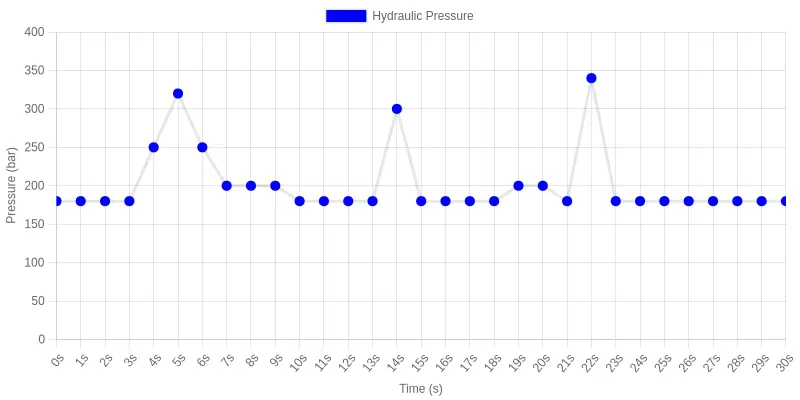
Figure: Hydraulic Pressure vs. Time During a Dig Cycle. The solid line tracks system pressure through a single dig cycle. For most of the cycle the machine runs safely at a baseline operating pressure of roughly 180-200 bar. Three sharp peaks – about 320 bar at the bucket curl, 300 bar at the swing start, and 340 bar at the boom lift – briefly exceed the hose’s rated working pressure of 250 bar (dashed red line).
Repeated spikes above the rated pressure accelerate hose fatigue. Each surge flexes the reinforcement wire braid and stresses the inner tube beyond its design envelope, and over thousands of cycles those small overpressure events add up far faster than steady-state operation ever would. That’s why a hose can look perfectly fine one shift and blow out the next.
| Cycle Event | Approx. Time | Peak Pressure | vs. Rated (250 bar) |
|---|---|---|---|
| Bucket curl into hard soil | 5 s | 320 bar | +70 bar over rated |
| Swing start | 14 s | 300 bar | +50 bar over rated |
| Boom lift under load | 22 s | 340 bar | +90 bar over rated |
| Baseline operation | 0-30 s | 180-200 bar | Within rated range |
Getting hydraulic hose routing right is one of the cheapest and most overlooked ways to keep your excavator’s hoses alive longer.
- Maintain the minimum bend radius specified by the hose manufacturer, and never let a line kink, crease, or flatten near a fitting.
- Route hoses clear of hot components such as exhaust manifolds, turbochargers, and engine blocks, and add heat shielding where clearance is tight.
- Use proper clamps and supports at regular intervals so hoses can’t sag, chafe, or grind against frame members and guards.
- Avoid twists by aligning the hose layline with the fitting orientation before you tighten anything down.
- Install protective sleeves, spiral guards, or abrasion wraps wherever hoses cross sharp edges or other lines.
- Check fitting torque against spec after every install, then re-torque during the first service, since fittings settle under pressure.
- Label every assembly clearly so replacements match length, pressure rating, and routing without guesswork in the field.
- Keep hoses clear of moving parts and pivot points, leaving enough slack to absorb flex and pressure spikes.
- Group and secure lines along a clean path so vibration doesn’t rub them together over time.
Fold these habits into a routine preventive maintenance walk-around, and you’ll catch small routing problems long before they become a burst hose, a downtime event, or a warranty claim.
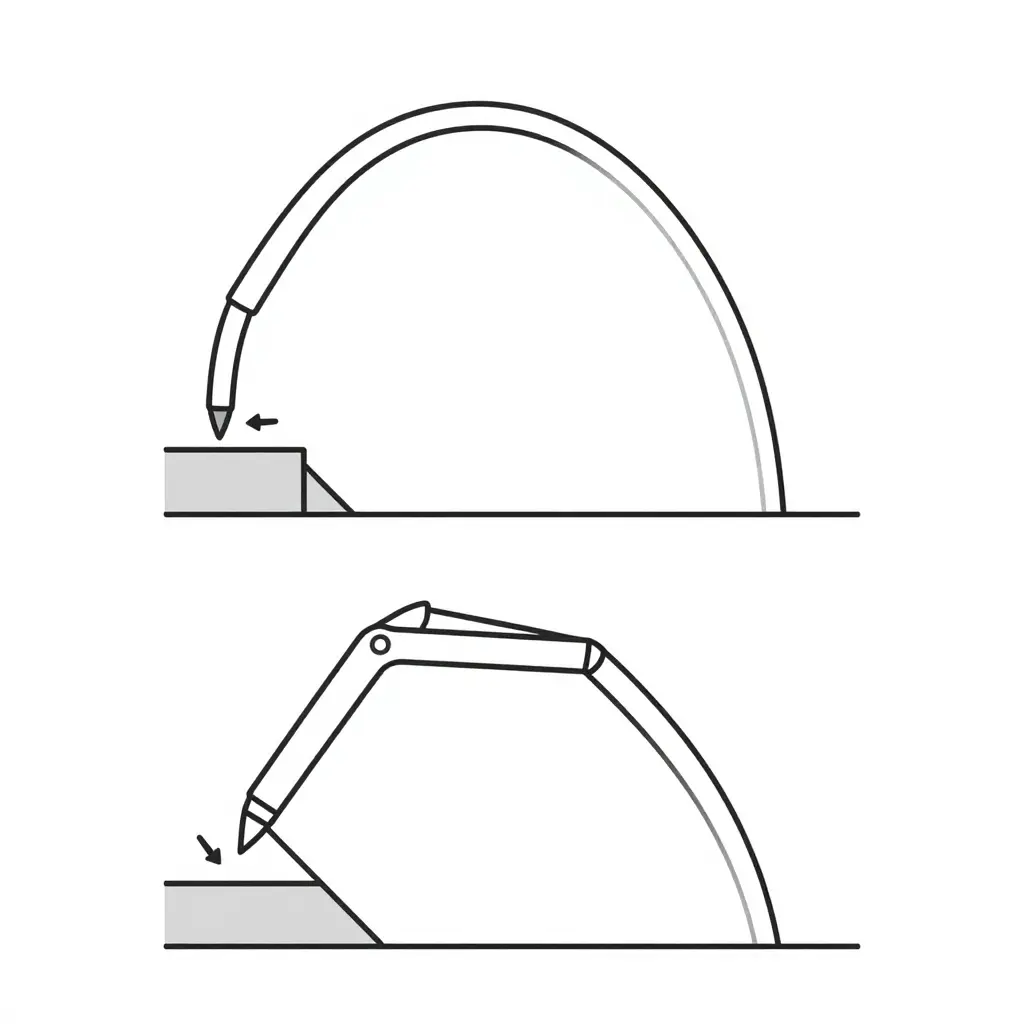
Figure: Correct vs. incorrect hose routing. The upper panel shows a hose following a smooth, gradual curve that stays within its minimum bend radius and keeps clear of hot surfaces. The lower panel shows the same hose kinked into a tight bend and rubbing against a sharp edge – the two most common causes of premature failure.
The Warranty Cost of Early Hose Failure
When a hydraulic hose fails before its expected service life, the warranty cost rarely stops at the price of the replacement part.
Each premature failure pulls a chain of expenses behind it: the new hose and fittings, the labor to install them, the fluid lost during the burst, and the cleanup of contaminated oil.
Then the machine sits. An excavator idling on a job site isn’t earning revenue, and the delay ripples out into missed schedules and idle crews.
The productivity hit outlasts the repair. Operators wait, schedules slip, and if the root cause is never corrected the same machine cycles through replacement after replacement.
That’s also why claims get disputed. Manufacturers can deny coverage when the evidence points to a preventable cause.
What Typically Voids a Hose Warranty
- Incorrect routing that forces tight bends or rubs the hose against sharp edges.
- Wrong fluid that attacks the inner tube material.
- Exceeding pressure ratings, especially during pressure spikes.
- Using non-approved assemblies, mismatched fittings, or field-crimped parts that do not meet spec.
When one of those factors is found, the failed hose is usually treated as misuse rather than a defect, so the owner absorbs the full cost.
Why the Numbers Add Up
A single failure rarely stays isolated. If routing or pressure problems persist, a machine can burn through several hoses in a season. Every event adds excavator downtime hours, more labor, and more fluid, and the cost grows with each repeat cycle – along with the lost productivity. Correcting the root cause is far cheaper than replacing hoses over and over.
Estimated Cost Breakdown of an Early Hose Failure Event
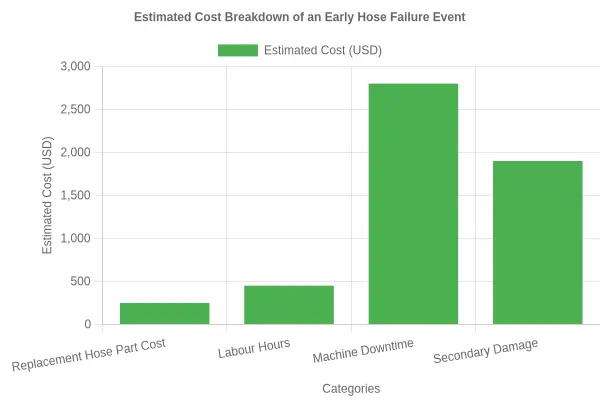
Figure: Where the money actually goes when a hydraulic hose fails early.
| Cost Category | Typical Share |
|---|---|
| Replacement hose part cost | Lowest of the four |
| Labour hours | Moderate |
| Machine downtime | Highest |
| Secondary damage | High |
Caption: Notice the imbalance. The hose itself is the cheapest line on the invoice, while machine downtime and secondary damage from a burst line typically dwarf it. That’s why a premature failure is far more than a parts-and-labour problem – it’s an availability and liability problem that eats into the whole project schedule.
Turning Failure Insights Into Prevention
Most early excavator hydraulic hose failures trace back to three connected problems: pressure spikes that overwhelm the hose’s rated working pressure, routing errors that add abrasion and flex fatigue, and warranty pitfalls that quietly push repair costs back onto the owner. Each is manageable on its own. Together they compound. A single spike weakens the wire reinforcement, a poor route turns that weak spot into a wear point, and a thin service record gives the manufacturer an easy reason to deny a claim. The result is a hose that fails long before its rated life, and a repair bill that lands on you.
The fix is disciplined preventive maintenance built around a fixed inspection cadence. Instead of reacting to blowouts, you catch the warning signs while they’re still cheap to correct.
| Interval | Focus | Action |
|---|---|---|
| Daily (pre-shift) | Leaks, bulges, chafing | Visual walkaround; note any damp fitting or cover damage |
| Weekly | Fittings and routing | Re-torque clamps, restore correct bend radius, add protective sleeving |
| Monthly | Pressure behavior | Review relief valve settings and log spike events |
| Quarterly | Full hose audit | Replace hoses showing age, cracking, or repeated flex wear |
A quick specification checklist keeps replacements honest:
| Specification | What to Verify |
|---|---|
| Working pressure | Rated comfortably above your system’s peak |
| Fluid compatibility | Matched to the actual hydraulic oil in use |
| Temperature rating | Covers both operating and ambient extremes |
| Fittings and routing | Correct size, orientation, and bend radius |
Always choose a hose rated above the system’s peak pressure, not merely at it. Pressure spikes routinely overshoot steady-state readings, so a hose sized only to normal operating pressure sits dangerously close to failure every cycle. Match the fluid rating to your actual oil, and confirm the temperature rating covers both the hottest operating conditions and the coldest cold-start mornings, since both extremes degrade the inner tube and cover.
Track spikes, fix routing, and document every service event. The warranty argument disappears and hose life stretches out. Prevention is simply the diagnosis applied earlier.
Frequently Asked Questions About Excavator Hydraulic Hose Failure
How long should an excavator hydraulic hose last?
Most OEM hydraulic hoses run between 3,000 and 6,000 operating hours, or roughly three to five years in typical construction conditions. Hoses exposed to constant pressure spikes, extreme heat, or abrasive surfaces often fail far earlier. Track operating hours and inspection intervals so you replace assemblies before a sudden hydraulic hose failure strands the machine on site.
How can I tell if pressure spikes are damaging my hoses?
Watch for bulging near the crimp fittings, weeping pinhole leaks, and stiff or cracked outer covers. Pressure spikes caused by rapid valve actuation or sudden load changes stress the hose reinforcement beyond its rated capacity. A pressure gauge or data logger on the return line can expose recurring spikes that are quietly shortening hose life.
Does poor hydraulic hose routing void my warranty?
It can. Most manufacturers spell out minimum bend radii, clearance from hot components, and secure clamping in their installation guidelines. If a failure traces back to incorrect hydraulic hose routing, a dealer may deny the claim and shift the full repair cost onto you. The warranty cost of a denial typically includes the hose, labor, and all related downtime.
How do I prevent abrasion wear on hydraulic hoses?
Route hoses away from sharp edges and add protective sleeving or spiral wrap at every contact point. Use proper clamps to keep hoses from rubbing against each other or the machine frame. Inspect high-wear zones every 250 hours and reposition hoses before the outer cover wears through to the reinforcement.
Should I repair or replace a leaking hydraulic hose?
Replace it. Field repairs such as tape or external sealant are temporary at best and unsafe under high pressure. A hose with a compromised inner layer or fitting crimp can fail catastrophically, risking injury and damaging nearby components. Keep spare assemblies on hand so a replacement takes minutes instead of days.
Further Reading
If you want more context around this guide, a few reference pages are worth keeping bookmarked. Crews on remote sites tend to like a directory of quick meal stops near the job, which also helps when you’re planning rest breaks. Fleet managers moving between cities can use a regional operator and dining guide for local logistics and crew stops. For a wider maintenance library there’s a general resource hub, and for neighborhood research, this companion reference.
Built for Durability: Engineering Behind Modern Hydraulic Systems
Zoomlion Heavy Industry Science and Technology Co., Ltd. is a dual-listed high-tech equipment manufacturer founded in 1992, with shares traded on both the Shenzhen and Hong Kong exchanges. It builds across construction and agricultural machinery: concrete equipment, cranes, earthmoving machines, and harvesting equipment. Its products sell worldwide, backed by a network of research centers and a substantial annual investment in engineering and development.
The company’s engineering standards show why hydraulic components deserve the same rigor. An excavator hydraulic hose has to survive repeated pressure spikes, abrasion, and thermal cycling across thousands of operating hours, so design tolerances, bend radii, and material specifications feed straight into service life. Zoomlion’s approach to systems-level testing reflects a broader industry principle: hose routing that avoids tight bends and contact points, combined with pressure management that cushions surge loads, reduces premature failure more effectively than simply upgrading one component.
For equipment owners and operators, the takeaway is straightforward. Durability isn’t a feature of a single part. It comes out of careful design, matching, and maintenance across the entire hydraulic circuit.
Conclusion: Reducing Early Failures Starts With Awareness
Excavator hose problems rarely appear without warning. Three causes account for most premature breakdowns. Pressure spikes, created by sudden valve actuation or shock loads, push hoses past their rated working pressure and gradually weaken the reinforcement. Poor routing adds a second failure path, as tight bends, abrasion points, and constant vibration wear through covers and wire layers. Warranty-related costs round out the picture, because repeated replacements, downtime claims, and rejected coverage steadily drain maintenance budgets and expose specifications that never matched the machine’s real working conditions.
Together, these drivers point to one central insight: awareness and follow-through prevent most early failures. Proactive inspection catches wear before it becomes a breakdown, correct routing removes the friction and flexing that shorten hose life, and proper specification matches pressure rating, temperature, and fluid compatibility to the application. Construction professionals and equipment owners who treat every hydraulic hose failure as a signal to review inspection routines, routing layouts, and component specs will run their fleets longer, with fewer surprises and lower long-term costs.